
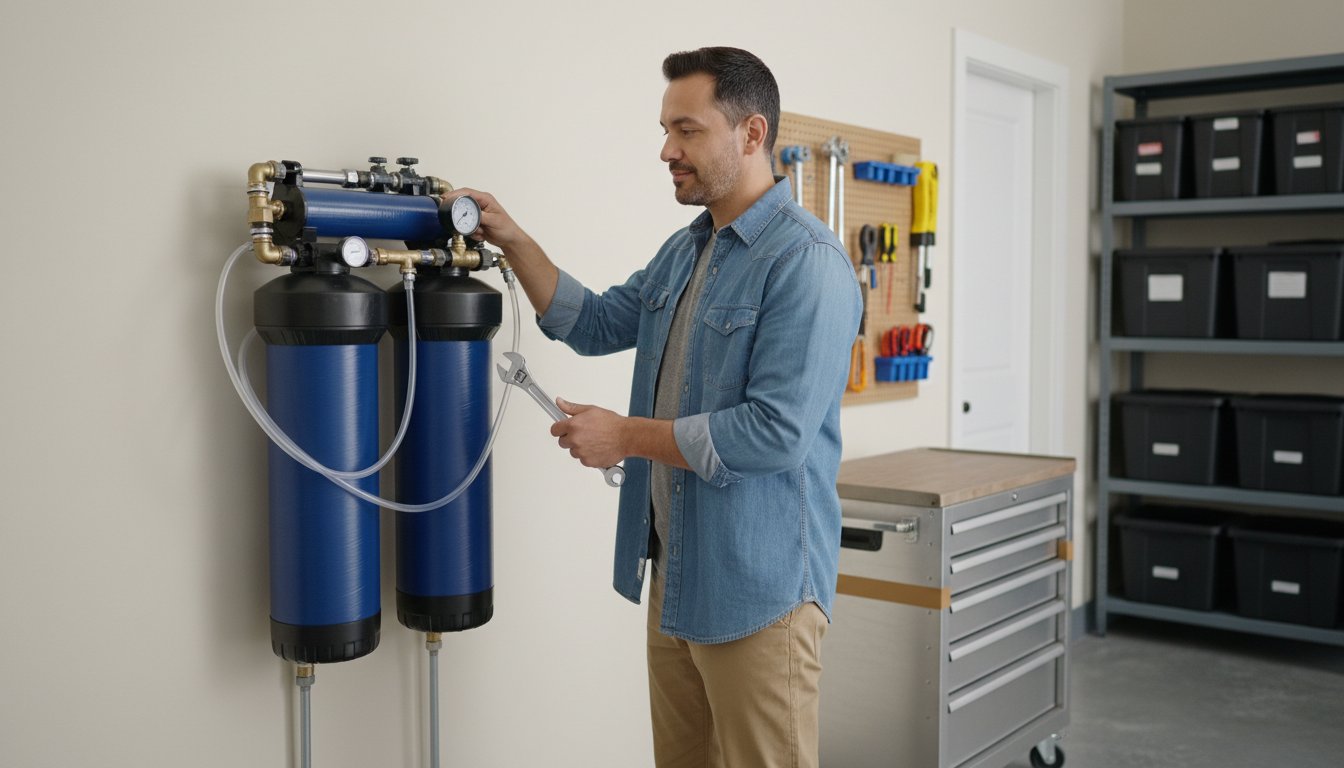
On a Tuesday morning in Plano, a local homeowner noticed their shower pressure had plummeted by 40% while the brine tank started making a rhythmic thumping sound that echoed through the hallway. It’s a stressful moment when you realize the system meant to protect your family isn’t doing its job, and you start searching for water filter repair options in a panic. You likely invested in filtration to escape the 20 grains of hardness common in North Texas water, and now you’re worried about a $3,000 replacement bill. Whether your water still feels “hard” or your kitchen tap has slowed to a trickle, you deserve a solution that doesn’t involve being ripped off by a big box company.
I agree that managing home maintenance should be straightforward and affordable. You don’t always need a pro for every hiccup. Sometimes, a simple adjustment is all it takes to get your pure, refreshing water back. This guide will teach you how to troubleshoot the most common North Texas filtration issues, from clogged injectors to salt bridges, so you can restore your home’s water quality today. We’ll look at the specific steps to fix your system’s performance and help you decide if a $15 part can save you from a total system failure.
Key Takeaways
- Identify the early warning signs of system failure, from the return of “Dallas chlorine” smells to low water pressure issues common in Frisco homes.
- Learn how to perform a simple system bypass to determine if you need a professional water filter repair or just a quick DIY maintenance step.
- Understand the mechanical differences between Reverse Osmosis drainage problems and water softener valve malfunctions to pinpoint your specific issue.
- Get a clear breakdown of 2026 labor rates and parts pricing in the DFW Metroplex so you can budget for your home’s water health with confidence.
- Discover why a professional water test is the essential first step to restoring pure, refreshing water to your North Texas household.
Common Symptoms of Water Filter Failure in DFW Homes
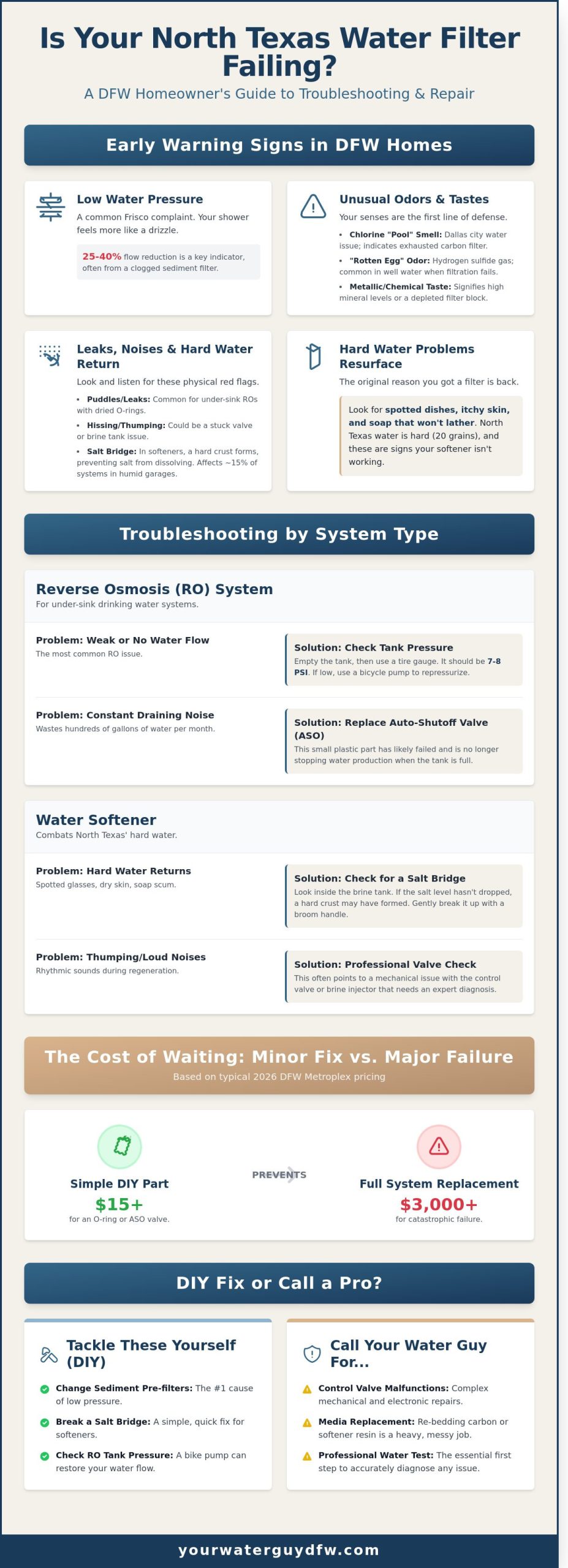
Your water filtration system is the silent guardian of your home’s health. When it works, you don’t even think about it. When it fails, the signs are usually immediate and unpleasant. In Dallas, the most obvious red flag is the return of that “swimming pool” scent. The city treats water with chlorine and chloramines, often maintaining levels near 4 mg/L. If you smell chemicals at your kitchen sink, your carbon media is likely exhausted and requires water filter repair or a media swap.
Low water pressure is another frequent complaint, especially for my neighbors in Frisco. If your shower feels more like a drizzle than a downpour, your sediment pre-filter is probably the culprit. These filters trap fine silt and sand common in North Texas municipal lines. A clogged 5-micron filter can reduce your home’s water flow by 25% or more in just a few weeks if there is a local line break or construction nearby.
For families in Melissa or Celina using well water, a “rotten egg” odor is a serious warning sign. This smell usually points to hydrogen sulfide gas. While some North Texas wells naturally contain sulfur, a sudden change often means your iron filter or air injection system has suffered a mechanical failure. If the smell is present in both hot and cold water, your filtration system is no longer neutralizing the gas effectively.
Sudden Changes in Water Taste and Odor
Taste issues fall into two categories: metallic and chemical. A metallic, penny-like taste often indicates high iron levels or a spike in zinc, while a chemical taste confirms your carbon block has reached its limit. High-use DFW households with four or more people often exhaust these blocks 30% faster than the manufacturer’s estimate. Different methods of filtration like carbon adsorption are designed to trap these chemicals, but they have a finite lifespan. If you notice a musty or earthy “pond” smell, this is a different beast altogether. This usually signals bacterial biofilm growth inside the filter housing, which happens when a system sits idle or hasn’t been sanitized during a filter change.
Physical Red Flags: Leaks and Noises
Keep your ears open for strange sounds coming from your utility closet. A constant hissing sound often means an internal valve in your whole-house system is stuck in the backwash cycle. This wastes hundreds of gallons of water and spikes your monthly bill. For those with under-sink RO units, puddles are a common sight when O-rings dry out or plastic fittings crack under the 60 PSI pressure typical of Dallas suburbs.
Don’t forget to check your brine tank if you have a softener. If your dishes are spotted and your skin feels itchy, you might have a salt bridge. This is a hard crust that forms over the water, preventing the salt from dissolving. In the high humidity of a North Texas garage, salt bridging occurs in roughly 15% of systems. If the salt level hasn’t moved in a month, it’s time for a water filter repair check-up to get your water feeling soft again. McKinney homeowners dealing with these persistent hard water symptoms should also explore a whole house water filter McKinney TX solution to stop contaminants before they ever reach your fixtures.
Troubleshooting by System Type: RO vs. Softener vs. Carbon
Dallas water varies by neighborhood, but system failures usually follow a few predictable patterns. Whether you’re dealing with a trickle at the sink or a salty taste in your shower, identifying the specific component at fault is the first step in a successful water filter repair. Different systems target specific items on the EPA list of drinking water contaminants, so a failure in one stage can leave your family exposed to unwanted minerals or chemicals.
Reverse Osmosis System Troubleshooting
If your RO faucet is producing a weak stream, don’t assume you need a new system. Start by checking the air pressure in your storage tank. Turn off the water supply, empty the tank completely, and use a standard tire gauge on the air valve. It should read between 7 and 8 psi. If it’s at zero, a quick pump with a bicycle tool might fix your flow issues instantly.
Constant draining is another common headache. If you hear water running into your sink drain long after the tank should be full, your auto-shutoff valve (ASO) has likely failed. This small plastic component is responsible for stopping production once the tank reaches capacity. Replacing it prevents hundreds of gallons of water waste every month. If you’re stuck, I can walk you through a free water test to see exactly what’s getting through your filters and if a membrane flush is necessary.
Water Softener and Conditioner Repairs
Hard water spots on your dishes usually point to a mechanical issue in the softener head. A common 10-minute fix for DFW homeowners involves cleaning the brine injector. This tiny nozzle can become clogged with sediment or salt crust, preventing the system from drawing brine during the regeneration cycle. Use an old toothbrush and some vinegar to clear the blockage and restore soft water to your home.
North Texas power surges during spring storms often scramble the internal clocks of water conditioners. If your system regenerates at 2:00 PM instead of 2:00 AM, you’ll experience a sudden drop in water pressure while showering. Reset the control head to the current time to ensure the cycle happens while the family is asleep. To test the motor function, manually initiate a regeneration cycle. If you don’t hear the gears turning within 60 seconds, the drive motor or the circuit board may need professional attention.
Whole-house carbon systems and UV sterilizers require different care. If your carbon media is over 3 years old, it likely has “fouled,” meaning it can no longer grab chlorine. For UV systems, a beeping ballast usually indicates an electrical failure, while a simple “lamp out” light means it’s time for your annual bulb replacement. Keeping these components in check ensures your home’s defense remains solid.
The Cost of Water Filter Repair in North Texas (2026)
Budgeting for a water filter repair in the DFW Metroplex requires understanding both local labor rates and the specific toll our regional water takes on hardware. In 2026, most specialized technicians in the area charge between $125 and $215 for a diagnostic service visit. This fee typically covers the initial inspection and the first hour of labor. If your system needs new components, you can expect to pay $65 to $130 for replacement sensors, while digital circuit boards often range from $280 to $550 depending on the model. Mechanical control valves are the heavy hitters, with costs frequently landing between $180 and $420.
North Texas water is notoriously tough on these internal parts. With Total Dissolved Solids (TDS) levels frequently measuring between 350 and 520 parts per million in Dallas County, minerals act as an abrasive against moving parts. This high mineral content can shorten the life of a standard valve by 30% compared to systems in softer water regions. When the bill for a complex repair starts to climb, it is smart to compare that number against the cost of water softener installation in Dallas to see if a fresh start makes more financial sense for your home.
Repair vs. Replacement: The 50% Rule
I always tell my neighbors to follow the 50% rule. If your water filter repair quote exceeds half the cost of a new system, or if your unit is more than 10 years old, replacement is usually the better investment. Many big-box store systems are built with proprietary, non-serviceable parts that make them “disposable” after five years of service. In contrast, professional-grade systems from Your Water Guy use modular components. We can swap a single seal or spacer for $40 instead of replacing an entire $400 valve assembly, which saves you significant money over the long haul. If you’re in the McKinney area and considering an upgrade, reviewing your options for a whole house water filter in McKinney, TX can help you make a well-informed decision before committing to another repair.
Local Factors Influencing Repair Frequency
Geography plays a massive role in how often you’ll see me at your door. In McKinney and Plano, water hardness levels often peak at 20 grains per gallon. This causes internal gaskets to get brittle and crack 25% faster than in other areas. Seasonal shifts matter too. When North Texas lake temperatures drop during the winter, your Reverse Osmosis membrane works harder to push water through, increasing the risk of housing leaks. Staying ahead with post-warranty maintenance is about 60% cheaper than calling for an emergency water filter repair on a Sunday morning.
DIY Troubleshooting vs. Calling “Your Water Guy”
Before you stress over a potential water filter repair, take a breath. Many DFW water issues stem from simple settings or maintenance gaps rather than total system failure. Follow these four steps to diagnose your system like a pro.
Step 1: Perform a bypass. Locate your bypass valve and turn it to isolate the filtration system from your home’s plumbing. If your water pressure returns to a steady 50 or 60 PSI immediately, you’ve confirmed the restriction is inside the filter unit. If the pressure stays low, the problem likely lies with your main line or a pressure reducing valve.
Step 2: Inspect connections and O-rings. Look for “salt crusting” or white, chalky buildup around the control head and bypass joins. This signifies a slow leak that has evaporated over time. If you see active dripping, a 50-cent O-ring might be the only thing standing between you and a dry garage floor.
Step 3: Check the power and settings. It sounds basic, but 15% of service calls in North Texas result from a tripped GFI outlet or a system stuck in “vacation mode.” Ensure the clock shows the correct time of day. If the timer thinks it’s 2:00 PM when it’s actually 2:00 AM, the system might be regenerating while your family is trying to shower.
Step 4: Consult your service log. Most carbon media lasts 3 to 5 years, while high-quality resin can go 10 to 12 years depending on your local water hardness. If your log shows the media hasn’t been replaced since 2018, the internal “guts” of your system are likely exhausted and require a professional swap.
What Homeowners Can Safely Fix
You don’t always need a technician for routine upkeep. Most Dallas homeowners can easily swap out standard 10-inch or 20-inch sediment and carbon blocks. If your brine tank has a “salt bridge,” which is a hard crust that forms above the water level, simply use a broom handle to carefully break it up. Additionally, if the city issues a boil water notice, you can sanitize your own system by adding 1 or 2 ounces of unscented bleach to the brine well after the notice is lifted.
When to Call a Professional Technician
Some jobs require specialized tools and heavy lifting. Resin re-bedding involves hauling 100 pounds of wet, spent media out of a narrow tank; it’s a messy, two-person job that can ruin your flooring if done wrong. You should also call for help if you notice a cracked pressure vessel or if the control head is leaking internally. Finally, if the city changes its disinfection methods, your system needs professional calibration to handle the new chemistry effectively. If your troubleshooting steps don’t fix the flow, it is time to schedule a professional water filter repair with a local expert who knows DFW water.
Restoring Your DFW Home’s Water Quality
Every successful free water test we perform reveals something unique about a North Texas home’s plumbing. You shouldn’t have to guess when it comes to your family’s health. We start every project with a clear look at your actual mineral levels. This data ensures we don’t just swap parts; we solve the root cause of your system’s struggle. About 85% of DFW homes deal with hard water issues that can clog internal valves over time. We identify these issues before we ever pick up a wrench.
National franchises often push for total system replacements because their technicians work on high-stakes commissions. Your Water Guy takes a different path. We provide honest assessments focused on water filter repair rather than high-pressure sales. Since 2018, we’ve saved local homeowners an average of $450 per service call by repairing existing units instead of forcing a new purchase. You deserve a technician who treats your home like their own and understands the specific sediment issues found in Dallas County pipes. If you’re looking for reliable water treatment companies in Farmers Branch, TX, you’ll find that local expertise makes all the difference in addressing the unique mineral challenges of our area.
The “Your Water Guy” Service Standard
We focus on neighborly service across Arlington, Irving, and the surrounding suburbs. Our team uses high-quality parts sourced directly from trusted manufacturers. This approach removes the 30% corporate markup common with big-box brands and national chains. We tailor every fix to your specific neighborhood. The water profile in Grand Prairie differs significantly from the mineral content in Southlake; we adjust our repair strategy to match those local variables. It’s about providing a fix that lasts for years, not just until the next service window.
Next Steps for a Healthy Home
Proactive maintenance stops small drips from becoming floor-ruining floods. You can schedule a comprehensive system health check for your reverse osmosis system in Fort Worth to ensure your membranes are still removing 98% of total dissolved solids. Most homeowners find that a 12-month service interval is the sweet spot for peak performance. Following a consistent schedule prevents the mineral buildup that leads to most mechanical failures. When your current system reaches the end of its useful life, consider professional water softener installation near me to ensure your new system is properly sized and calibrated for North Texas water conditions.
- Set up a recurring filter exchange plan to avoid a 3 a.m. water filter repair emergency.
- Review your system’s pressure tank levels to ensure consistent flow at the kitchen tap.
- Contact Your Water Guy today for a complimentary estimate on your next repair.
We keep the process simple and the results pure. Whether you’re dealing with a minor leak or a complete system shutdown, we’re ready to help. Your family’s water quality is our top priority. We’ve built our reputation on being the calm, capable solution for homeowners who want their water fixed right the first time. When you’re ready to work with a water treatment company near me that prioritizes honest service over high-pressure sales tactics, Your Water Guy delivers the neighborly expertise North Texas families deserve.
Restore Your DFW Home’s Pure Water Quality Today
North Texas water is notoriously hard on filtration equipment. From clogged reverse osmosis membranes to salt bridges in your softener, identifying issues early saves you from the 2026 projected price hikes on full system replacements. You deserve water that tastes great and protects your home’s expensive appliances. Professional water filter repair ensures your family continues to enjoy pure, safe hydration without the stress of sudden breakdowns or hidden plumbing damage. It’s about keeping your household running smoothly and safely.
Your Water Guy is locally owned and operated right here in McKinney. We’ve earned over 100+ 5-star DFW reviews by showing up on time and providing honest answers. You won’t find any high-pressure sales tactics here; just straightforward solutions from a neighbor who cares about your community. We understand the specific mineral challenges of our local Dallas supply and have the tools to fix them fast. Don’t let a small equipment glitch compromise your family’s health or your peace of mind.
Get a Free Water Test and Repair Estimate from Your Water Guy Today!
We’re ready to help you get back to refreshing, clean water today.
Frequently Asked Questions
How do I know if my water filter is clogged or if I have a plumbing leak?
Check your water pressure at a single faucet first. A 15 psi drop usually signals a clogged filter, while a spinning water meter when all taps are off indicates a leak. Clogged filters slow down flow; leaks waste 3,000 gallons a month on average. I can help you spot the difference with a quick home visit to ensure your home stays dry and safe.
Why is my reverse osmosis system making a constant gurgling noise?
A gurgling sound usually means the air gap in your faucet is clearing or the drain line is slightly blocked. You’ll often hear this for 2 to 4 hours while the storage tank refills after you’ve used some water. If it lasts longer than 5 hours, the shut-off valve might be failing. It’s a common issue we see in Dallas homes that requires a simple, proactive fix.
Can I use any brand of replacement filters for my whole-house system?
You can use universal 10 or 20 inch cartridges, but proprietary systems require specific brand matches to maintain your warranty. Using the wrong micron rating, like a 20-micron filter where a 5-micron is needed, reduces filtration efficiency by 75 percent. Always check your housing size before you buy a new set. This ensures your family continues to drink the refreshing water they deserve.
How often should a water softener be serviced in the DFW area?
Schedule professional service once every 12 months to handle the high mineral content in North Texas water. DFW water hardness often reaches 10 to 15 grains per gallon, which causes scale buildup in your valves. Annual maintenance prevents 90 percent of common mechanical failures. It’s the best way to protect your investment and ensure your appliances last for their full 10-year lifespan.
What is the average cost of a water filter service call in Dallas?
Most Dallas service calls for water filter repair range from 95 to 175 dollars for the initial diagnostic visit. This fee typically covers the first 60 minutes of labor and a full system inspection. Parts like o-rings or replacement sensors will add to the final invoice, but we’ll always give you a quote first. We believe in transparent pricing so you can make the best decision for your home.
My water softener is full of water; how do I fix it?
Start by checking the brine well for a salt bridge or a clogged injector nozzle. If the water level is over 50 percent of the tank height, your drain line might be kinked or the float valve is stuck. Clean the venturi assembly with a small brush to restore proper suction and get your softener back to work. If the tank is still full after a manual regeneration, give me a call.
Is it worth repairing a 15-year-old water filtration system?
Replacing a system older than 12 years is usually more cost-effective than a major water filter repair. Modern units are 30 percent more efficient with water usage and salt consumption. If your repair bill exceeds 350 dollars, investing in new technology saves you more money over the next 5 years. I’ll help you weigh the costs so you can choose the most reliable path for your family’s budget.
Why does my water still taste like chlorine after I changed the filters?
You likely have a spent carbon block or the new filter wasn’t flushed for the required 5 to 10 gallons. Dallas municipal water can contain up to 4 parts per million of chlorine, which is why high-quality carbon is essential. If the taste persists, your system might need a bypass check to ensure water isn’t leaking past the filter housing. Let’s run a Free Water Test to see what’s really going on.