
Last Tuesday, a homeowner in McKinney showed me a $600 designer showerhead that was completely clogged with white, crusty buildup after just 14 months of use. It’s a frustrating reality here in North Texas, where water hardness levels frequently climb above 18 grains per gallon. Many local families are finding that a water softener with reverse osmosis is the only reliable way to stop this mineral damage while finally getting rid of that harsh, pool-like chlorine taste.
You probably already know that DFW water is notoriously tough on your plumbing, your hair, and your morning coffee. Dealing with spotted dishes and that lingering chemical smell isn’t just annoying; it’s an expensive drain on your home’s value and your daily comfort. You deserve water that works for your family instead of causing constant chores.
I’m going to show you exactly how pairing these two systems creates the ultimate solution for pure, soft water in every room. This guide breaks down the best configurations for North Texas homes so you can enjoy protected appliances and bottled-quality water straight from your kitchen tap without the high-maintenance headache.
Key Takeaways
- Stop fighting North Texas “very hard” water by learning how to protect your home’s plumbing and appliances from scale buildup.
- Discover how pairing a water softener with reverse osmosis creates a “bodyguard effect” that extends the life of your filters and provides pure drinking water.
- Compare the benefits of whole-house protection versus point-of-use purification to ensure your family gets the best water at every tap.
- Learn how to correctly size a system for your DFW home based on your family size and local mineral levels.
- Find out why choosing a local expert for your water bundle provides better protection and value than big-box corporate brands.
Understanding the DFW Water Duo: Softeners vs. Reverse Osmosis
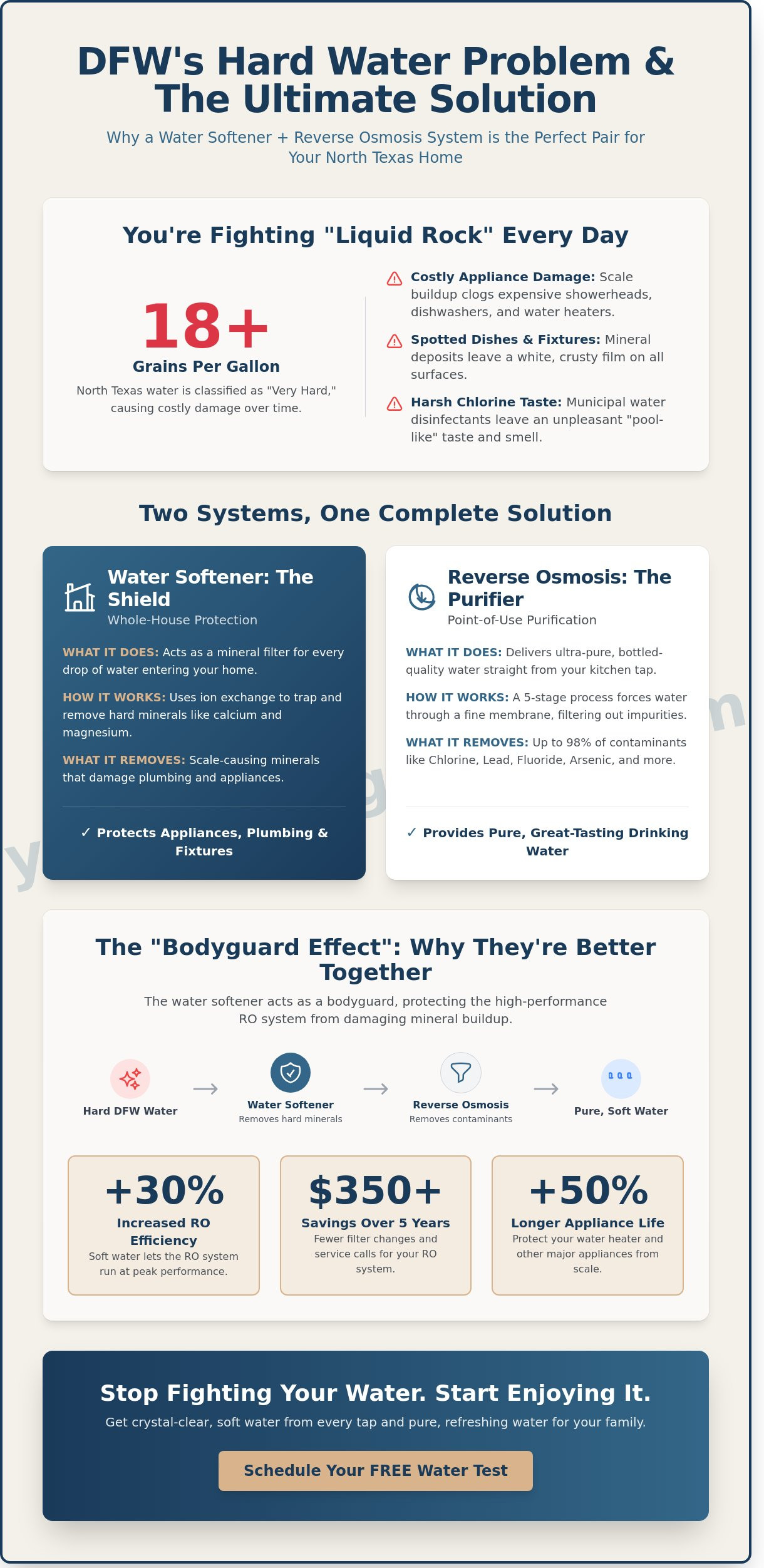
North Texas water is notoriously tough on homes. The U.S. Geological Survey (USGS) classifies water with more than 180 mg/L of dissolved minerals as “very hard,” and many DFW neighborhoods regularly hit these levels. This liquid rock flows through your pipes every day, leaving behind scale that destroys expensive appliances. However, a softener alone isn’t a complete solution for your family’s health. While it protects your plumbing, it doesn’t address the chemical disinfectants or heavy metals found in municipal supplies. That is why smart homeowners in McKinney and Frisco are increasingly installing a water softener with reverse osmosis to get the best of both worlds.
The core difference is simple. A water softener provides whole-house protection. It treats every drop of water that enters your home, from the showerhead to the garden hose. Reverse Osmosis (RO) is a point-of-use purification system. It typically sits under your kitchen sink to provide “bottled water” quality for drinking and cooking. You need the softener to save your water heater, but you need the RO system to ensure your family isn’t drinking chlorine or lead. If you’ve ever wondered do I need reverse osmosis for city water in Dallas-Fort Worth, the answer depends on your specific municipal supply and what contaminants it carries. Your Water Guy DFW recommends this duo because it addresses the two distinct problems of North Texas water: mineral hardness and chemical additives.
What is a Water Softener?
A softener acts as a mineral filter for your entire home. It uses a process called water softening through ion exchange. Inside the tank, resin beads act like a magnet to pull calcium and magnesium out of the water, replacing them with a tiny amount of sodium. This prevents scale buildup in your $1,200 water heater, extending its life by up to 50%. You’ll notice your dishes come out of the dishwasher without spots, and your skin feels “slippery” or smooth after a shower. That sensation isn’t soap residue; it’s the natural feel of your skin without a layer of rock dried onto it.
What is Reverse Osmosis (RO)?
If the softener is the shield, the RO system is the polisher. This 5-stage filtration process forces water through a semi-permeable membrane that is so fine it catches microscopic contaminants. It removes up to 98% of total dissolved solids (TDS), including fluoride, arsenic, and lead. Most importantly for DFW residents, it strips away the heavy chlorine taste and smell used by local water districts. The result is pure, refreshing water at your kitchen tap. You can stop buying plastic water bottles and trust that your morning coffee tastes exactly how it should. Grab a Free Water Test from Your Water Guy DFW to see exactly what your current tap water is hiding.
The Science of Synergy: Why They Work Better Together
Think of your water softener as a dedicated bodyguard for your drinking water system. While installing a water softener with reverse osmosis might seem like a luxury, it is actually a strategic move for North Texas homeowners. These two systems perform entirely different jobs, but they work in a partnership that saves you money and improves your quality of life. The softener focuses on the “working water” used for bathing and laundry, while the RO system perfectes your “drinking water.”
The “Bodyguard Effect” happens when the softener removes calcium and magnesium before the water ever reaches your RO unit. These minerals are the primary cause of scale buildup. When raw, hard DFW water hits a delicate RO membrane, it creates a layer of rock-like crust that chokes the system. By feeding the RO system pre-softened water, you ensure it runs at peak performance. This synergy creates a complete circle of protection for your plumbing, your appliances, and your family’s health.
This principle of proactive protection applies to other valuable assets, not just your plumbing. Many homeowners apply the same logic to their vehicles, using specialized treatments to prevent damage from the harsh Texas environment. If you’re interested in that type of advanced protection for your car, you can check out Dripping Auto Pros.
Protecting Your RO Investment
Hard water is the number one killer of RO membranes in the Dallas-Fort Worth area. Most local tap water registers between 12 and 20 grains of hardness. Without a softener, your RO membrane has to fight through those minerals constantly. This leads to frequent, expensive filter replacements. Pre-softened water allows the RO system to operate with 30% more efficiency. Over a 5-year period, this setup can save you $350 or more in replacement parts and service calls. The University of Missouri provides a comprehensive guide to home water treatment that details how these individual components manage different contaminants to keep your home running smoothly.
The Ultimate Taste and Safety Profile
Soft water feels great on your skin, but it isn’t designed for drinking. Softeners don’t remove chemicals, and they actually add a tiny amount of sodium during the ion-exchange process. The RO system acts as the final polisher. It strips away that added sodium along with lead, fluoride, and arsenic. It also tackles the notorious “swimming pool” smell common in Dallas city water. Because the RO system removes 98% of dissolved solids, the water tastes crisp and clean. You get the best of both worlds: soft water for your hair and skin, and bottled-quality water from your kitchen tap. If you want to see the difference for yourself, you can schedule a free water test to check your current hardness and chlorine levels.
- Whole-Home Protection: The softener prevents scale in your water heater and dishwasher.
- Pure Hydration: The RO system removes contaminants the softener cannot touch.
- Extended Lifespan: Softened water can double the life of your RO membrane.
- Sodium Removal: The RO system filters out the salt used in the softening process.
This duo is the only way to achieve truly “perfect” water in North Texas. It addresses the physical damage caused by minerals and the chemical concerns found in municipal supplies. When you combine a water softener with reverse osmosis, you stop reacting to water problems and start controlling your home’s environment.
Water Softener vs. RO: A Comparison for DFW Homeowners
Living in Plano or Richardson means dealing with some of the hardest water in North Texas. While both systems improve your quality of life, they tackle entirely different problems. A water softener focuses on your home’s infrastructure and plumbing, while a reverse osmosis system focuses on the water your family actually consumes. Understanding these differences helps you decide if a water softener with reverse osmosis is the right combination for your specific household needs.
Feature and Function Comparison
A water softener is your whole-house bodyguard. It typically sits in your garage or attic, intercepting minerals before they reach your water heater or showerhead. It primarily removes calcium and magnesium, which protects your $1,200 dishwasher and $2,000 water heater from scale buildup. Conversely, an RO system is a point-of-use specialist. It usually hides under your kitchen sink, using a semi-permeable membrane to strip away up to 99% of contaminants like lead, fluoride, and arsenic. Many homeowners on city water ask whether a reverse osmosis system is truly necessary for DFW municipal water — and the answer often comes down to the specific trace contaminants your local supply carries. For a technical breakdown of these processes, this guide on Household Water Treatment explains how these technologies function to improve your home’s supply.
- Softener: Covers every tap, focuses on mineral removal, and saves your pipes.
- RO System: Covers one dedicated tap, focuses on chemical and heavy metal purity, and provides bottled-quality drinking water.
Maintenance Expectations in North Texas
North Texas water is notoriously tough on filtration equipment. Our local supply often carries high sediment levels that can clog standard filters faster than the national average. For your softener, expect to add a 40-pound bag of salt every 4 to 6 weeks depending on your family’s water usage. RO systems are lower daily maintenance but require a full filter swap once a year.
In cities like Richardson, I recommend checking your sediment pre-filters every 6 months because of local pipe debris. Scheduling a professional water filter system service ensures your membranes don’t foul early. This proactive approach saves you from the cost of premature system failure caused by the heavy mineral content found in DFW.
Which System Do You Need?
Your choice depends on your primary frustration. If your skin feels itchy after a shower or your glassware looks cloudy, a softener is your priority. If you’re tired of the “pool smell” of chlorine in your coffee or worry about what’s in your children’s drinking water, an RO is the answer. Most local families find that a water softener with reverse osmosis provides the most complete protection for both their home and their health.
- Choose a Softener if: You want to stop scale on faucets and make your soap lather better.
- Choose an RO if: You want pure water for drinking, ice making, and cooking.
- Choose Both if: You want to protect your appliances while ensuring your family drinks the cleanest water possible.
Installation and Sizing: Getting it Right for Your Texas Home
Sizing your system correctly is the difference between enjoying endless soft water and wasting money on extra salt. In the DFW area, water hardness typically ranges from 8 to over 20 grains per gallon. If you live in a suburb like Frisco or Prosper, you are likely on the higher end of that scale. To find the right fit, multiply your family size by the average daily water usage of 75 gallons, then multiply that by your hardness level. A family of four in a 15-grain area needs a system that can handle 4,500 grains of hardness every single day. Choosing a water softener with reverse osmosis ensures that while the softener handles these heavy minerals, the RO unit stays protected from scale buildup.
Integration depends heavily on your home’s age and layout. Most North Texas homes built after 2002 include a “softener loop” in the garage. This pre-installed plumbing makes the setup straightforward because the main water line is already diverted to a specific spot. If your home lacks this loop, we perform a main line cut-in. This involves intercepting the water line before it branches off to your water heater and fixtures. We also have to account for the drain requirement. Both systems must discharge brine and filtered impurities, which requires a nearby standpipe or a professional tap into your home’s waste line.
Where Does it Go? Space Requirements
Most DFW homeowners opt for a garage installation for the whole-house softener. It keeps the salt bags out of the house and provides easy access for maintenance. For the drinking water side, your water softener with reverse osmosis setup usually puts the filtration unit under the kitchen sink. However, we can also install RO systems in utility rooms and run a dedicated line to your refrigerator. If you live in a high-density area like Uptown Dallas, space is at a premium. You should explore compact water softeners for townhomes that provide full-scale protection without hogging your floor space.
Professional vs. DIY Installation
While DIY kits exist, the risks in North Texas are unique. Many newer homes use PEX piping, which requires specialized expansion tools and fittings to prevent leaks. Older homes may have corroded copper that needs expert soldering. Beyond the pipes, calibration is where pros earn their keep. We program the control valve based on your specific water test results. This precision can improve your salt efficiency by 25 percent compared to out-of-the-box settings. For a guaranteed leak-free setup, look into professional water softener installation Dallas services to protect your investment.
Don’t guess on your home’s water needs. Contact Your Water Guy DFW today for a free water test and a custom sizing recommendation.
Why Your Water Guy is the DFW Expert for System Bundles
Choosing a water softener with reverse osmosis shouldn’t feel like a high-stakes negotiation. You’re trying to protect your home and family, not get upsold on features that don’t fit your lifestyle. I founded Your Water Guy to give DFW homeowners a better option. We skip the corporate markups and the high-pressure sales tactics that plague the big national brands. You get a neighborly approach focused on solving your specific water problems with a system that actually works for your budget.
Bundling these two systems is the smartest way to achieve total water quality. While a softener protects your pipes and appliances from the 15 to 22 grains of hardness common in North Texas, the RO system ensures your drinking water is 99% free of contaminants. It’s a complete solution that provides peace of mind for every tap in the house.
The Local Advantage
I live here, I drink this water, and I understand the DFW grid better than a corporate office sitting in another state. North Texas water is notoriously hard and often heavily treated with chloramines. A big box “one-size-fits-all” kit isn’t designed for these specific mineral loads. When you work with me, you get a system tailored to your specific zip code and home size.
I personally handle the assessment and recommendation process. This ensures you aren’t just another number on a spreadsheet. You get professional reliability from a local expert who takes pride in every installation. If you are currently comparing options, see how we rank among the best water treatment companies near me to see why local expertise beats a corporate script every time.
Start with a Free Water Test
Every North Texas suburb has a slightly different water profile. Fort Worth water chemistry doesn’t look exactly like the water in McKinney or Frisco. That’s why I never recommend a water softener with reverse osmosis bundle without testing your tap first. My free home water assessment is comprehensive and takes about 20 minutes. We look for specific issues including:
- Hardness levels: Measuring the exact grains of calcium and magnesium.
- Chlorine/Chloramines: Identifying the disinfectants used by your municipality.
- Total Dissolved Solids (TDS): Checking the overall purity of your drinking water.
- Physical Impurities: Checking for sediment or cloudiness.
This data allows me to build a custom solution for your home. You’ll see the results right in your kitchen before you spend a dime. It’s time to stop guessing and start enjoying the pure, refreshing water your family deserves. Reach out today to schedule your no-obligation test and take the first step toward perfect water.
Take Control of Your North Texas Water Quality
You don’t have to settle for the hard minerals and chemical tastes common in DFW tap water. Pairing a water softener with reverse osmosis creates a complete home solution that stops scale buildup in your pipes and delivers 99% pure drinking water right to your kitchen. Based in McKinney, our team has analyzed over 5,000 local water samples to understand exactly how North Texas minerals affect your plumbing and health. We focus on getting the installation and sizing right the first time so your system runs efficiently for years. As a locally owned and operated business, we provide no-pressure, expert recommendations tailored to your family’s specific needs. You deserve water that’s safe, soft, and refreshing for your kids and your home. Let’s get your water chemistry back on track today.
Get Your Free DFW Water Test & System Estimate Today!
Your Water Guy is ready to help you enjoy the best water North Texas has to offer.
Frequently Asked Questions
Do I really need both a water softener and reverse osmosis?
Yes, because these systems perform two different tasks to protect your home. The softener removes calcium and magnesium that cause scale, while the RO removes 98% of dissolved solids like lead, arsenic, and chlorine. In North Texas, where hardness often exceeds 15 grains per gallon, using a water softener with reverse osmosis ensures your appliances stay protected while your family drinks pure, bottled-quality water.
Can I install a reverse osmosis system without a water softener?
You can, but it isn’t ideal for DFW homes. Without a softener, the high mineral content in local water will clog the RO membrane within 6 months instead of the typical 2 years. This leads to frequent, expensive filter replacements and reduced water flow. Protecting your RO with a softener extends the life of the system by 300% and keeps your maintenance costs low.
How much does it cost to install both systems in a DFW home?
A professional installation typically ranges from $2,500 to $4,500 depending on your plumbing layout and equipment capacity. This investment includes a high-capacity softener and a multi-stage RO unit. Many homeowners find this pays for itself within 3 years by eliminating the need for bottled water and preventing $1,200 in annual plumbing repairs caused by mineral scale buildup in water heaters.
Does a water softener make the water salty to drink?
No, softened water doesn’t taste like salt. The softening process adds a small amount of sodium, roughly 12.5 milligrams per 8-ounce glass, which is less than what you find in a single slice of bread. If you’re on a low-sodium diet, the reverse osmosis system removes this sodium entirely. You get the benefits of soft water for your skin and the pure taste of RO for your coffee.
How often do I need to change the filters on my RO system in Texas?
You should replace the sediment and carbon pre-filters every 12 months to maintain peak performance. In cities like Plano or Frisco where TDS levels can hit 400 ppm, the main RO membrane usually lasts 2 to 3 years if you have a softener. I recommend a Free Water Test once a year to verify your system is still hitting that 95% rejection rate for contaminants.
Will a water softener and RO system affect my home’s water pressure?
You won’t notice a drop in pressure at your showers or toilets with a properly sized softener. A standard 48,000-grain system handles 12 gallons per minute, which is more than enough for a 3-bathroom home. The RO system uses a dedicated faucet or fridge line, so it doesn’t affect your main sink pressure. Your Water Guy ensures every install maintains optimal flow throughout the house.
Can these systems be installed in a rental home or apartment?
Yes, we offer compact RO units and portable softening options that don’t require permanent plumbing changes. Under-sink RO systems only need a small 0.5-inch hole in the countertop or sink basin for the faucet. If you move, 90% of the equipment can be disconnected and reinstalled at your new DFW residence. It’s a smart way to protect your health without losing your security deposit.
What happens if I have hard water but only install a reverse osmosis system?
Your RO membrane will likely fail in under 12 months due to mineral scaling. Calcium buildup creates a rock layer on the membrane, forcing the system to waste 5 gallons of water for every 1 gallon produced. By pairing a water softener with reverse osmosis, you prevent this fouling. This combination ensures your drinking water stays pure while your system runs at 98% efficiency.