

Last Tuesday, a homeowner in Frisco watched their three year old dishwasher finally stop working, choked to death by the thick, white mineral crust that plagues almost every North Texas pipe. It’s a frustrating story I hear every week across the Metroplex, where our water often averages a harsh 15 to 20 grains of hardness. You already know that this liquid rock is destroying your expensive appliances and leaving your skin feeling dry after every shower. Finding a trustworthy water softener installation near me shouldn’t feel like a gamble with a big-box subcontractor who treats your home like just another work order number.
I’m here to help you take back control of your plumbing. This guide provides a clear, expert-backed checklist to prepare your DFW home for a professional installation that actually handles our unique local water quality. You’ll learn how to accurately calculate your household’s grain capacity requirements for 2026, identify the ideal spot for your system loop, and understand the real requirements for a long-term solution. Let’s get your home protected with the soft, pure water your family deserves.
Key Takeaways
- Learn why standard units struggle with North Texas’s 15-25 grain hardness and how to select a system built specifically for the DFW Metroplex.
- Use our simple checklist to locate your home’s softener loop and determine the best spot for your water softener installation near me.
- Uncover the truth about the “hidden markup” at national retailers and the benefits of choosing a dedicated local pro over a big-box subcontractor.
- Master the post-installation essentials, from choosing the right salt pellets to knowing when a quick professional tune-up is needed to protect your investment.
Understanding Why You Need Water Softener Installation in the DFW Metroplex
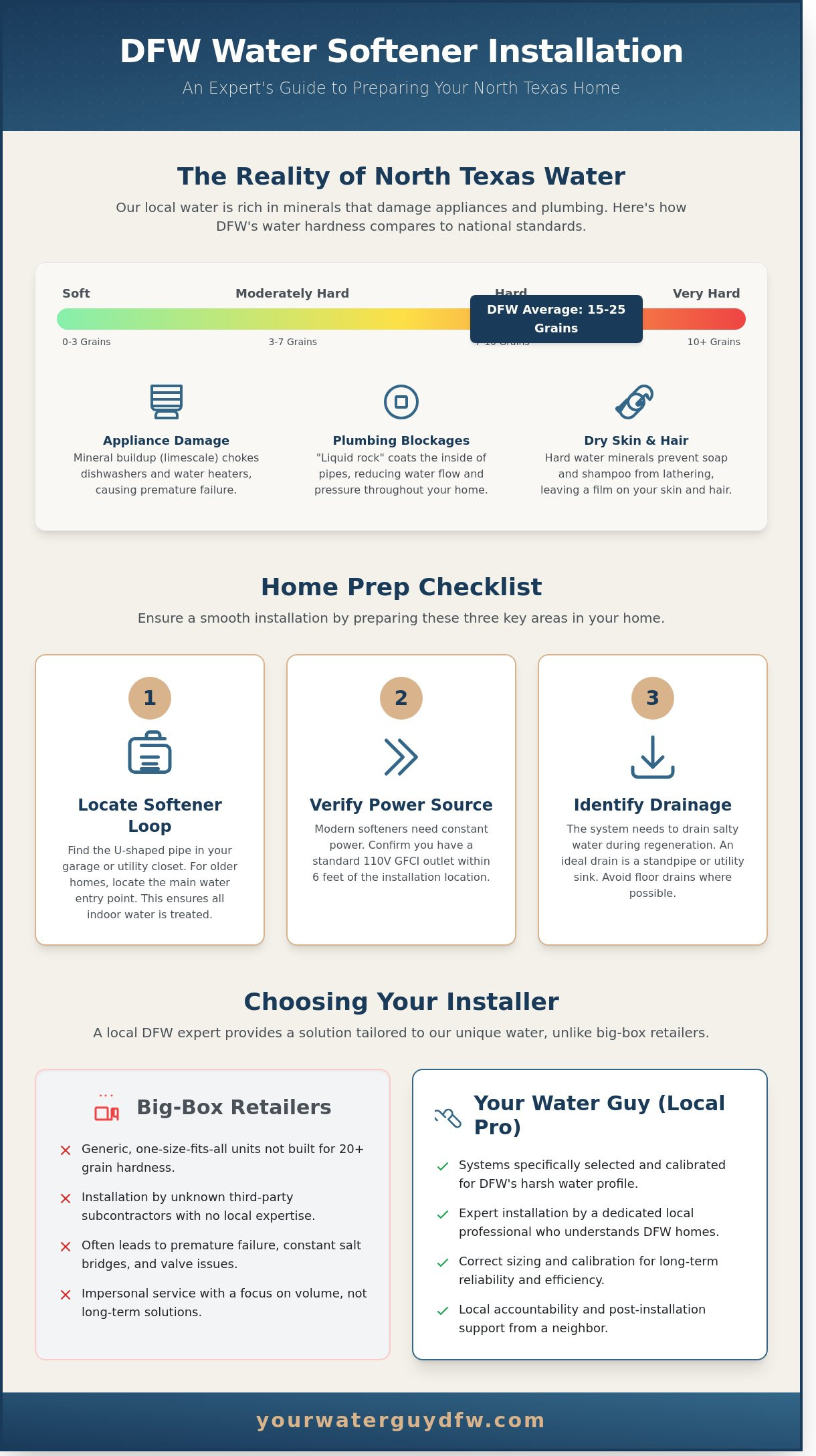
Living in North Texas means dealing with some of the toughest water conditions in the country. Most of our local supply comes from the North Texas Trinity River basin, which is naturally rich in calcium and magnesium. While these minerals aren’t harmful to drink, they’re absolute wrecking balls for your plumbing. In cities like Dallas and Fort Worth, we regularly see hardness levels between 15 and 25 grains per gallon. To put that in perspective, anything over 10 grains is considered “very hard” by industry standards.
Many homeowners try to save a few bucks by grabbing a generic unit from a big-box retailer. These “average” softeners usually fail within a few years because they aren’t built for our specific mineral profile. They often lack the capacity to handle 20-grain water, leading to constant salt bridges and internal valve failure. If you’re searching for water softener installation near me, you need a system calibrated for the DFW reality, not a “plug-and-play” appliance designed for a different state. Professional installation ensures your system is sized correctly so it doesn’t burn out prematurely.
Understanding what water softening is helps you realize why a custom setup matters. The process involves a precise ion exchange that requires specific timing and flow rates. When a system isn’t dialed in for our 25-grain peaks, you’ll see the same old signs of damage: white crusty buildup on your expensive Moen faucets, itchy skin after a shower, and water heaters that die five years too early due to sediment. I’ve seen brand-new dishwashers ruined in less than 24 months because of North Texas lime scale.
The Reality of North Texas Water Hardness
In municipalities like Frisco and Plano, the water hardness can fluctuate based on lake levels and seasonal shifts. This high mineral content acts like liquid sandpaper inside your pipes. It’s not just about the spots on your wine glasses; it’s about the layer of rock forming inside your tankless water heater. You can verify your own levels with a simple at-home test. Fill a clear water bottle halfway with tap water, add ten drops of basic dish soap, and shake it. If the water looks cloudy and has very few bubbles, you’re living with hard water that’s costing you money every day.
Why a “Near Me” Search Requires a Local Expert
Choosing a local expert for water softener installation near me gives you an advantage a national 1-800 number can’t match. We understand DFW water pressure fluctuations, which are critical for proper valve calibration during the regeneration cycle. Furthermore, a local technician knows how to work with our unique North Texas soil and slab foundations. We don’t just “hook it up.” We ensure the drainage and loop placement won’t interfere with your home’s structural integrity. Hiring a neighbor means you get local accountability and a system that’s actually built to survive the Trinity River basin’s mineral load.
The Essential Pre-Installation Checklist for North Texas Homes
If you’re searching for water softener installation near me, you likely already know that North Texas water is notoriously hard on your plumbing and skin. Before the installation team arrives, you need to ensure your home is ready for the upgrade. Proper preparation prevents delays and ensures your system runs efficiently from day one. Start by verifying your main water shut-off valve. If it hasn’t been turned in 10 years, it might be seized. Test it now to ensure it’s functional, as we’ll need to kill the water supply during the install.
Locating Your Softener Loop and Main Line
Many newer builds in McKinney, Allen, and Frisco come equipped with a “softener loop.” This is a U-shaped pipe, typically located in the garage, that’s already tied into your home’s main water line. It makes the installation process much faster. If your DFW home was built before 1990, it’s unlikely to have this feature. In these older homes, we look for the main water entry point, which is often near the front of the house or inside a utility closet. Understanding how water softeners work helps you see why the loop location is critical; it ensures every drop of water entering your home, except perhaps your outdoor hose bibs, gets treated.
Power and Drainage Requirements
Modern water softeners aren’t just tanks of resin; they use smart valves that require a constant power source. You’ll need a dedicated 110V GFCI outlet within six feet of the installation site. Using extension cords is a safety hazard and can lead to power fluctuations that reset your valve’s programming.
Drainage is the next priority. During the regeneration cycle, the system needs to discharge brine water. Common drainage options in North Texas include:
- Floor Drains: The simplest option, common in modern DFW garages.
- Standpipes: Similar to your washing machine drain.
- P-Traps: A plumbed-in solution that prevents sewer gases from entering the home.
Local DFW codes often require an “air gap” between the discharge line and the drain to prevent cross-contamination. This is a small but vital detail that keeps your family’s drinking water safe.
Space is your final consideration. A standard brine tank and resin tank combo requires about 9 to 12 square feet of floor space. Measure your available area to ensure you have enough room to comfortably pour 40-pound bags of salt into the tank without straining your back. If you’re unsure if your space fits the bill, Your Water Guy DFW can help you evaluate your garage or utility room layout during a quick consultation.
Confirming these details now saves you from unexpected plumbing costs later. When you’re ready to move forward with a water softener installation near me, having your loop, power, and drain ready makes the transition to pure, soft water seamless. It’s about protecting your home and your family with a setup that’s built to last.
Comparing Your Installation Options: Big Box Stores vs. Your Water Guy
Searching for water softener installation near me often leads you straight to the aisles of national retailers. It feels convenient to grab a system while you’re picking up light bulbs, but these larger stores operate on a “Hidden Markup” model. They typically add a 15% to 25% administrative fee to the installation cost just to manage the paperwork between you and their third-party contractors. You’re paying a premium for a middleman who never actually touches your plumbing.
The Subcontractor vs. The Specialist
Big-box stores don’t send their own employees to your house. They use a subcontractor lottery where you have no control over who shows up. These installers are often paid a flat rate per unit rather than an hourly wage, which creates a massive incentive to rush. A rushed job leads to bypassed loops, improper drainage, and potential leaks that might not show up for months.
When you choose a reliable water treatment company near me, you’re investing in personal accountability. At Your Water Guy, I don’t hide behind a corporate logo. I live and work in the DFW area, which means my reputation is on the line with every house I visit. You get neighborly service and a direct line to the person who did the work, ensuring your system is dialed in for your specific family needs.
Hardware Quality and Longevity
Retail-grade softeners are designed for the “average” American home, but North Texas water is anything but average. Most big-box units are built with thin plastic rotary valves and low-grade resin that frequently fail within 3 to 5 years. This happens because they aren’t built to withstand the high mineral concentrations found in our local supply. To understand the science, the U.S. Geological Survey explains what causes hard water and how calcium and magnesium levels impact your home’s infrastructure.
- Professional Resin: I use 10% cross-linked resin that is physically tougher and lasts up to 20 years, even with chlorinated city water.
- Precision Calibration: Professional systems are custom-programmed for your home’s hardness levels. This saves you roughly 30% on salt and water waste compared to the generic factory settings of retail units.
- Serviceable Parts: Unlike “disposable” retail units, professional valves are designed to be cleaned and repaired, not thrown in a landfill.
Choosing a professional water softener installation near me means you’re buying a long-term solution rather than a temporary fix. You’ll avoid the “bargain” trap that leads to spotted dishes and dry skin again in just a few short years. Your family deserves a system that works as hard as you do.
Step-by-Step: What to Expect During Your DFW Water Softener Setup
When you search for a water softener installation near me, you want a local expert who understands the unique mineral profile of North Texas. My process begins the moment I pull into your driveway. We’ll start with a final site assessment to confirm the drain path and power access. I’ll walk you through the plan so there are no surprises once the tools come out. I verify your water loop or main line location to ensure the most efficient route for your new system.
The core of the setup involves integrating the system into your home’s plumbing. I use high-quality, lead-free fittings to ensure a permanent, leak-free seal. Whether we’re cutting into a pre-plumbed loop or the main line, I install commercial-grade bypass valves. This gives you total control, allowing you to switch back to city water easily if you ever need to service the unit without losing water to the rest of the house.
The Plumbing and Media Loading Process
I prioritize the longevity of your resin. I “pre-bed” the resin tank with water before adding the media. This prevents the resin from compressing too tightly, which keeps your flow rate high and prevents pressure drops. Before I open the valves to your home, I run a specialized sanitization cycle. This 20-minute flush removes any factory particulates or dust. It ensures the first drop of water hitting your kitchen tap is pure and safe for your family.
Programming for North Texas Efficiency
North Texas water is notoriously hard, often testing between 15 and 22 grains per gallon in cities like Dallas and Plano. I don’t use “out of the box” settings. I program your valve specifically for your household size and local water data. This custom calibration reduces salt consumption by up to 25% compared to standard setups. I’ll also show you how to activate “vacation mode.” This smart feature prevents the system from regenerating while you’re away, saving you money and water.
The final step is the “Hand-Off.” This is what sets a professional water softener installation near me apart from a big-box store delivery. I’ll show you exactly where to pour your salt and how to read the salt level indicator. You’ll also learn how to use the manual bypass valve. It’s a simple 90-degree turn that gives you peace of mind. I won’t leave until you feel 100% confident operating your new system.
Protecting Your Investment: Post-Installation Care for North Texas
North Texas water is notoriously hard on plumbing. Protecting your system starts the moment you finalize a water softener installation near me and begins with consistent, simple maintenance. Your system works 24 hours a day to strip away minerals like calcium and magnesium. To keep it running at peak efficiency, you need to be proactive about what goes into the brine tank.
Choosing the right salt is your first line of defense. High-purity pellets are the gold standard for most DFW homes because they contain evaporated salt and often include citric acid to help clean the resin beads. Crystals are a less processed option, but they are prone to clumping. If you are monitoring your sodium intake, potassium chloride is an excellent alternative. It performs the same softening function but replaces the sodium with potassium. Be aware that potassium typically costs three to four times more than standard salt pellets.
While modern systems are built for durability, periodic water filter repair is a rare but vital part of ownership. Monitoring your pre-filters ensures that heavy sediment from municipal lines doesn’t reach the softening resin. A yearly health check by Your Water Guy ensures your valve settings match the current hardness levels of your local water supply, which can fluctuate based on lake levels and seasonal changes.
Salt Management and Maintenance
Check your brine tank levels at least once every four weeks. For an average family of four in the Dallas area, you will likely consume one 40 pound bag of salt per month. Don’t let the tank go empty; keep it at least one-third full at all times. You should also plan to clean the brine tank every 12 to 18 months. Over time, salt creates a “sludge” or “mush” at the bottom of the tank that can clog the intake.
During humid DFW summers, when humidity levels often exceed 70%, keep an eye out for a salt bridge. This is a hard crust that forms above the water level, making the tank look full even though the water underneath is empty. If you notice your water feels hard despite a full tank, gently break the crust with a broom handle. This simple fix often restores soft water immediately without needing a service call.
When to Call for Expert Support
Troubleshooting becomes necessary if you experience a sudden drop in water pressure or if your water begins to taste salty. These symptoms often indicate a mechanical issue with the bypass valve or a clog in the brine line. If your salt levels haven’t moved in two months, your system isn’t regenerating properly. This is when the expertise of a local professional becomes invaluable.
Investing in a local water softener installation in Dallas provides the peace of mind that your technician understands our regional mineral profile. We don’t just fix the machine; we calibrate it for the specific challenges of North Texas water. If your system is over 10 years old or showing signs of struggle, it’s time for a professional evaluation. Schedule your free DFW water test with Your Water Guy today!
Take Control of Your North Texas Water Quality Today
The hard water across the DFW Metroplex isn’t just a minor nuisance; it’s a direct threat to your home’s plumbing and appliances. North Texas water frequently measures over 15 grains per gallon of hardness. According to data from the Water Quality Association, this level of mineral buildup can slash the efficiency and lifespan of your water heater by up to 50 percent. You’ve now seen how the right checklist and a professional setup can safeguard your investment for 2026 and beyond. By preparing your home for a custom system, you ensure your family enjoys pure, soft water for years.
Don’t settle for a generic solution from a national chain that doesn’t understand our specific regional mineral profiles. Finding the best water softener installation near me means partnering with a team that’s locally owned and operated right here in North Texas. We provide no-pressure, neighborly consultations designed to protect your family’s health and your home’s value. It’s time to stop scrubbing scale off your fixtures and start enjoying a home that’s truly cared for.
Get Your Free DFW Water Test and Installation Quote
We’re ready to help you turn your hard water headaches into a thing of the past. Your home deserves the best care, and we can’t wait to show you the difference that local expertise makes for your family.
Frequently Asked Questions
How much does water softener installation cost in Dallas for 2026?
Professional installation costs in Dallas for 2026 are expected to follow national averages from Forbes Home, which currently range from $1,000 to $3,000. Prices vary based on labor rates and material costs, which have seen a 4% annual increase according to recent economic reports. I provide transparent quotes based on your home’s specific plumbing needs. This ensures you pay a fair price for a system that actually works.
Can I install a water softener myself in my DFW home?
You can technically install a system yourself, but most DFW homeowners find the risks outweigh the savings. A single loose fitting can lead to thousands of dollars in water damage to your foundation or flooring. Choosing professional water softener installation near me gives you peace of mind and a labor warranty. I make sure every connection is watertight and your system is calibrated for North Texas mineral levels.
Do I need a permit for water softener installation in North Texas?
Yes, most North Texas municipalities like Dallas and Frisco require a plumbing permit for new water softener installations. These rules ensure that your system drains safely into the sanitary sewer without contaminating the local water supply. I take care of the permit process for you. This keeps your home up to code and prevents issues when you eventually decide to sell your property.
How long does a typical professional installation take?
A standard professional installation takes between 2 and 4 hours to complete. If your home is already pre-plumbed with a loop, I can often finish the job on the shorter end of that window. More complex projects that require running new copper or PEX lines might take a full afternoon. I work efficiently to minimize the time your water is turned off during the process.
What is the best type of water softener for Dallas city water?
High-capacity ion-exchange systems work best for Dallas water because they effectively remove the 10 to 15 grains of hardness found in the local supply. I recommend a system that includes a carbon filtration stage. This combination tackles both the hard minerals and the chlorine smell that affects 75% of city residents. Your family will notice the difference in every glass of water and every shower.
Will a water softener affect my home’s water pressure?
A properly sized water softener won’t negatively affect your water pressure. Most residential units provide a flow rate of 12 to 15 gallons per minute, which exceeds the needs of a standard four-bedroom home. Pressure drops only happen if the system is too small or the internal resin tank becomes clogged with sediment. I’ll test your flow rate to ensure your showers stay strong and refreshing.
How do I know if my DFW home is already pre-plumbed for a softener?
Check your garage or water heater closet for a plumbing loop, which is a U-shaped pipe sticking out of the wall. About 85% of North Texas homes built after 2010 come with this feature. If you see two capped pipes near your main water shut-off, your home is ready for a quick setup. If you’re unsure, I can identify your plumbing configuration during a free water test.
What happens to the wastewater from the softener regeneration?
The wastewater produced during the regeneration cycle drains safely into your home’s sanitary sewer system. A typical cycle uses between 25 and 50 gallons of water, which is similar to the amount used by a high-efficiency washing machine. This water carries away the minerals that were trapped by the resin beads. It’s a necessary part of keeping your water soft and your appliances protected from scale.