

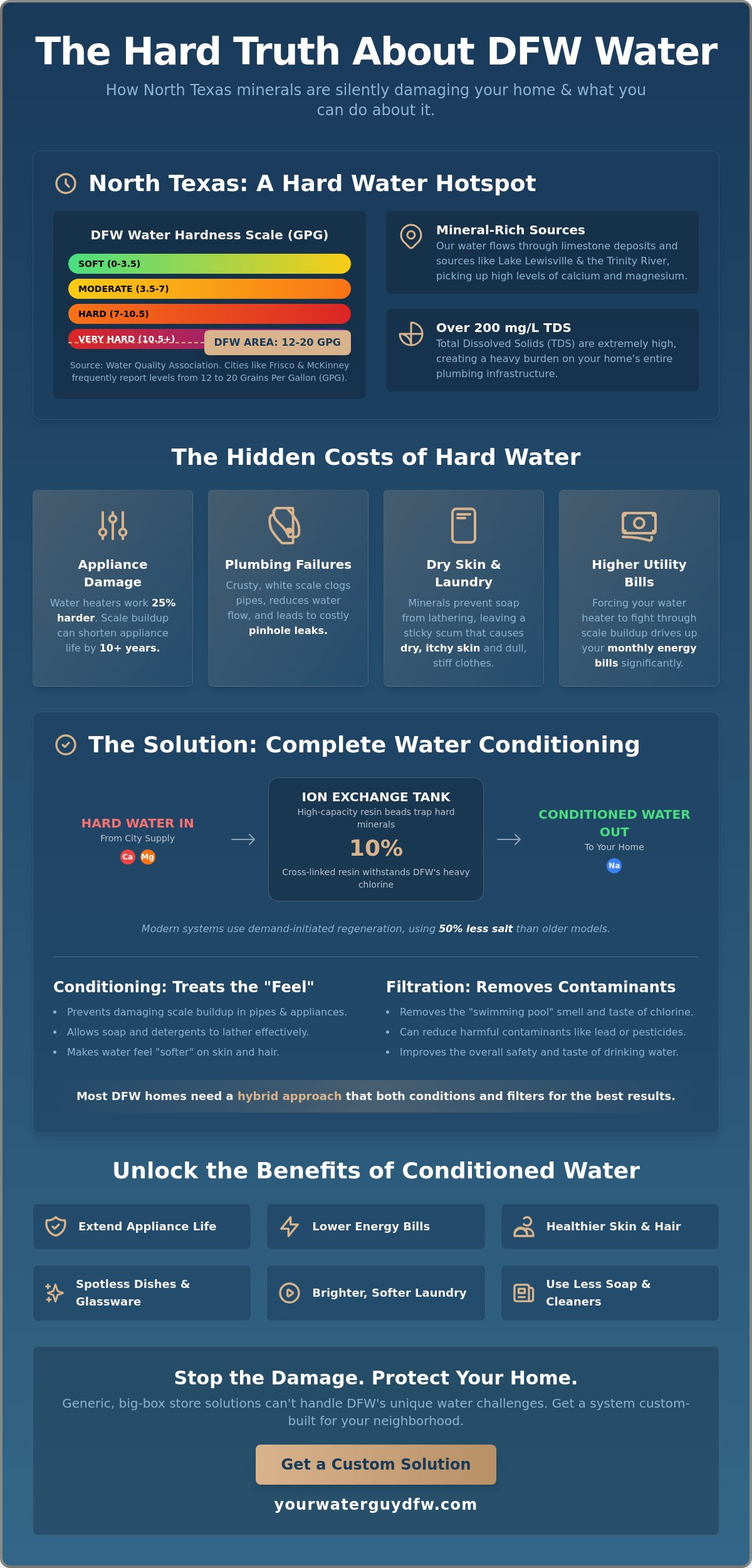
That white, crusty buildup on your showerhead isn’t just an eyesore; it’s a warning sign that North Texas minerals are quietly destroying your plumbing. Most DFW homeowners don’t realize that our local water often contains over 200 milligrams per liter of calcium and magnesium. This hard water creates a thick layer of scale inside your water heater, forcing it to work 25% harder and driving up your monthly energy bills. If you’re tired of dealing with dry, itchy skin and want to learn how water conditioning can stop the damage, you aren’t alone.
You’ve worked hard to build a beautiful home, and you deserve water that treats your family and your fixtures with care. This 2026 guide explains how these systems differ from basic softening to provide a complete solution for your household. You’ll discover how the right setup can extend the life of your appliances by 10 years or more while giving you clear skin and better tasting water from every faucet. We’ll look at the specific mineral profiles found across the Metroplex and help you choose a low maintenance system that works for your specific neighborhood.
Key Takeaways
- Understand how North Texas limestone impacts your water and learn the best ways to protect your home’s plumbing from scale.
- Compare salt-based and salt-free technologies to determine which system best fits your family’s lifestyle and maintenance preferences.
- Discover how professional water conditioning goes beyond standard softening to extend the life of your appliances and lower your energy bills.
- Identify the visual cues and hidden warning signs that suggest your DFW home is overdue for a water system upgrade.
- Learn why a custom-built system tailored to your specific neighborhood’s water data outperforms generic “big box” store solutions.
What is Water Conditioning and Why Does DFW Need It?
Water conditioning is a broad term for transforming your home’s water quality by removing excessive minerals and harsh chemicals. It’s about taking the basic utility water the city provides and making it high-performance. While city plants focus on making water safe by killing bacteria, they don’t focus on how that water feels on your skin or what it does to your expensive appliances. In the Dallas Metroplex, water conditioning is the bridge between “safe” water and “quality” water.
In North Texas, we deal with a specific geological reality. Our water travels through vast deposits of limestone before it reaches your tap. This results in high levels of Total Dissolved Solids (TDS). TDS measures the combined content of all inorganic and organic substances in your water. In the Dallas area, this number is usually driven by calcium and magnesium. These minerals create a heavy burden on your home’s infrastructure that city treatment plants simply aren’t designed to handle.
The Hard Truth About Dallas Water Hardness
Cities like Frisco and McKinney frequently report water hardness levels ranging from 12 to 20 Grains Per Gallon (GPG). For context, the Water Quality Association considers anything over 10.5 GPG as “very hard.” Our local water sources, including Lake Lewisville and the Trinity River, are naturally rich in minerals that create stubborn scale buildup. Hard water acts as the primary catalyst for DFW plumbing failures, leading to pinhole leaks and ruined heating elements in your water heater.
- Lake Lewisville: High mineral content from local runoff.
- Trinity River: Complex mineral profiles that fluctuate with the seasons.
- Limestone Deposits: The source of the white, crusty buildup on your faucets.
Conditioning vs. Filtration: Understanding the Scope
It’s easy to confuse these terms, but they serve different roles. Water conditioning focuses on treating the “feel” and the physical effects of water, such as preventing scale or making soap lather better. Filtration is about removing specific contaminants like chlorine, lead, or pesticides. Because DFW water is both chemically treated and mineral-heavy, most homeowners find that a hybrid approach works best for their families.
You need a system that addresses the hard minerals while also scrubbing away the swimming pool smell of city chlorine. If you are looking for water treatment companies near me, make sure they understand these local nuances. Your Water Guy DFW looks at your specific neighborhood’s water profile to build a solution that actually lasts. We don’t believe in one-size-fits-all fixes for North Texas homes. We focus on protecting your pipes and your peace of mind with water conditioning solutions built for our specific regional challenges.
How Water Conditioning Works: Science vs. Sales Talk
Let’s cut through the marketing noise and look at the actual chemistry. Water conditioning isn’t a mystery or a magic trick. It is a calculated process designed to fix the specific mineral issues we face here in the Dallas Metroplex. In 2026, the technology has moved far beyond the clunky, salt-heavy tanks your parents had in their garage. Modern systems are leaner, smarter, and much more efficient.
The heart of a high-quality system is the resin. We use high-capacity, 10% cross-linked resin beads because they stand up to the heavy chlorine used in North Texas city water. Cheaper resins break down in three to five years, but professional-grade materials stay effective for over a decade. These systems are also significantly more sustainable than older models. Thanks to demand-initiated regeneration, a modern unit uses 50% less salt than systems built just ten years ago. It only cleans itself when it needs to, not on a blind timer.
The Ion Exchange Process Explained
Think of resin beads like tiny magnets. These beads are covered in “soft” sodium ions. As hard North Texas water flows through the tank, the beads grab onto “hard” minerals like calcium and magnesium. They swap the hard minerals for soft ones. This is the ion exchange. Once the beads are full of calcium, the system performs a regeneration cycle to flush those minerals away and reset the beads.
You will feel this change immediately. When you remove those minerals, soap lathers properly instead of turning into sticky scum. This means you use less shampoo and your clothes come out of the wash feeling softer. To keep this chemical swap working at peak performance, you should follow a consistent water softener maintenance north texas schedule. Keeping your brine tank clean and using high-purity salt pellets ensures the resin stays efficient for years.
Beyond Softening: Carbon and Chemical Removal
True water conditioning handles more than just hardness. Most DFW municipal water carries a heavy scent of chlorine or chloramines, which cities use to disinfect the pipes. It’s why your tap water often smells like a swimming pool. Our conditioning systems include dedicated carbon stages that scrub these chemicals out before the water hits your faucet. This is the first line of defense for your family’s skin health, preventing the dryness and irritation that chlorine causes.
For homeowners who prefer a salt-free approach, physical water conditioning is an alternative. This uses Template Assisted Crystallization (TAC) to change the structure of minerals so they don’t stick to your plumbing. While it doesn’t “soften” the water in a traditional sense, it protects your water heater and appliances from scale buildup. If you want to see which technology fits your home best, set up a free water test with us today.
Salt-Based vs. Salt-Free: Which Fits Your North Texas Lifestyle?
Choosing between salt-based and salt-free systems is the most common crossroad I see homeowners face. These two technologies approach water conditioning with completely different philosophies. A salt-based system uses ion exchange to physically pull calcium and magnesium out of your pipes. It swaps those hard minerals for a tiny amount of sodium. In contrast, salt-free systems act as conditioners or descalers. They use a process called Template Assisted Crystallization (TAC) to change the chemical structure of minerals so they don’t stick to your fixtures. They stay in the water, but they won’t build up as scale.
Maintaining these systems looks very different too. With a traditional softener, you’ll be hauling 40-pound bags of salt into your garage or utility closet every few weeks. Salt-free systems usually only require a media or cartridge change once every 12 to 24 months. You also need to consider DFW drainage requirements. Salt-based systems produce brine that must be discharged into the sewer line during a regeneration cycle. Most North Texas cities require a specific air gap or P-trap to handle this discharge safely. If your home doesn’t have a nearby drain or if you’re worried about the environmental impact of brine, a salt-free unit might be your best bet.
When to Choose a Traditional Softener
If your water test shows hardness levels above 10 grains per gallon (GPG), which is common in many DFW neighborhoods, I usually recommend a salt-based system. This is the only way to achieve that signature slippery feel where soap lathers instantly and skin stays hydrated. Because it removes the minerals entirely, it offers the highest level of protection for your plumbing. If you want a total mineral purge for your home, check out my guide on water softener installation Dallas to see how we handle these high-capacity setups.
The Case for Salt-Free Conditioners
Salt-free systems are the perfect fit for compact water softeners for townhomes and condos north texas where square footage is tight. Since they don’t need a bulky brine tank or a dedicated drain line, they tuck away into small closets or under-sink areas easily. These systems are excellent descalers that protect your expensive tankless water heater and appliances. They don’t add sodium to your water, making them the preferred choice for people on low-sodium diets. If you want to stop scale without the hassle of heavy salt bags, this water conditioning method keeps your home running smoothly with minimal effort.
Signs Your DFW Home Needs a Conditioning Upgrade
Living in the DFW area means dealing with some of the hardest water in the country. You’ll likely notice white, chalky spots on your wine glasses or a stubborn film on your shower doors that won’t scrub away. This isn’t just a cleaning nuisance; it’s a clear signal that your home’s water conditioning needs an upgrade. In North Texas cities like Richardson and McKinney, calcium and magnesium levels are often high enough to cause permanent “etching” on glass surfaces. You might also notice a distinct metallic or chemical scent when you turn on the tap, which is the standard “city water” profile common across the Metroplex.
Your body feels the effects before you even see the scale. If your skin feels itchy and dry after a shower, or if your hair feels like straw no matter how much conditioner you use, the water is the culprit. Hard water minerals prevent soap from lathering properly, leaving a sticky residue on your skin that clogs pores and strips away natural oils. It’s a frustrating cycle that many DFW homeowners mistake for a need for better lotions when the solution is actually at the source.
The Hidden Cost of Hard Water on DFW Appliances
Hard water is a silent killer for your plumbing and appliances. Industry data from the U.S. Bureau of Reclamation shows that just 1/16th of an inch of scale buildup can slash your water heater’s efficiency by 15%. This means you’re paying significantly more on your monthly energy bills for less hot water. In high-growth areas like Plano and Frisco, homeowners often see high-end Bosch or Miele dishwashers fail years before their expected lifespan because internal valves get choked with minerals. You can check your own home today with this quick inspection:
- Unscrew the aerator from your kitchen faucet and check for white pebbles.
- Look at your showerhead nozzles for uneven spray patterns caused by mineral blockage.
- Check the back of your toilet tank for a “sand-like” texture on the bottom.
- Inspect the heating element of your electric kettle for white crust.
Water Quality and Your Family’s Health
The impact of water quality goes beyond your pipes. There is a documented link between hard water and skin conditions like eczema. The minerals and high chlorine levels found in North Texas municipal water can aggravate sensitive skin, especially in children. When you take a hot shower, the chlorine used by treatment plants evaporates into the steam, which you then breathe in. High-quality water conditioning removes these chemicals before they enter your home’s air. To see exactly what’s in your pipes, it’s a good idea to research the water softener system companies in the area and request a professional test.
Don’t let hard water damage your home or your health. Contact Your Water Guy DFW for a free water analysis today.
Getting Started: Why “Your Water Guy” is the DFW Choice
Choosing the right water conditioning system shouldn’t feel like a corporate transaction. When you walk into a big box store or call a national franchise, you’re often met with a salesperson reading from a rigid script. These companies sell generic units built for a national average, not for the specific mineral challenges found in North Texas. Your Water Guy offers a different experience. We’re your neighbors, and we believe your home deserves a solution built for DFW water.
Our approach centers on local accountability. Unlike corporate models that outsource their labor to third-party contractors, we handle the professional installation and post-warranty support ourselves. This means you have a direct line to a local expert if you ever have a question. We don’t use high-pressure tactics or confusing jargon. We provide honest advice based on your home’s needs and your family’s budget. It’s a straightforward process designed to give you peace of mind without the corporate headache.
Custom Solutions for North Texas Homes
Every DFW neighborhood has a unique water profile. A home in McKinney might deal with 12 to 20 grains per gallon of hardness, while a property in rural Denton County on a private well often struggles with high iron or that distinct sulfur smell. A one-size-fits-all unit from a warehouse store can’t handle these variations effectively over the long term. We build custom systems tailored to your specific neighborhood data. Whether you need a heavy-duty iron filter for a well or a high-efficiency softener for city water, we provide quality equipment that fits your life. We remain committed to affordability, ensuring you get a premium system without the bloated franchise price tag.
Schedule Your Free DFW Water Analysis
The first step toward better water is knowing exactly what’s in it. We offer a free on-site water analysis to test your GPG levels and chlorine content. This 20 to 30-minute test gives us the data we need to make an accurate recommendation. Our focus is on finding the right system for your house, not the most expensive one on the truck. We’ve built our reputation on this neighborly service, treating every customer with the respect they deserve. Ready to see the difference? Contact Your Water Guy today to schedule your free test and start your journey toward pure, refreshing water for your entire family.
Protect Your DFW Home with Better Water Today
North Texas water presents unique challenges for homeowners in 2026. With local mineral levels often exceeding 200 milligrams per liter of calcium carbonate according to regional water quality data, your plumbing and appliances face constant stress. Choosing the right water conditioning system isn’t just about avoiding spots on your dishes; it’s about safeguarding your family’s comfort and your home’s long-term value. Whether you prefer a salt-based softener for that silky feel or a salt-free system for low maintenance, the right fit depends on your specific neighborhood and lifestyle needs.
You shouldn’t have to guess what’s in your pipes or deal with high-pressure sales tactics from national chains. Your Water Guy DFW is locally owned and operated right here in the Metroplex. We provide custom-built systems designed specifically for North Texas mineral profiles. Our team offers expert-led, no-pressure consultations to ensure you get exactly what you need without the fluff. Let’s get your water back to its best state so you can enjoy every drop.
Get Your Free DFW Water Test and Custom Quote Today!
We’re ready to help you transform your home’s water quality. You’ll love the difference that clean, conditioned water makes for your family.
Frequently Asked Questions
Is Dallas water considered hard or soft?
Dallas water is officially classified as hard, with mineral concentrations typically measuring between 120 and 190 milligrams per liter according to local municipal water reports. This range falls into the hard to very hard category established by the U.S. Geological Survey. You will see the evidence of this in the white crust on your showerheads or the stubborn spots on your dishes. It is a persistent issue for almost every household across the DFW metroplex.
What is the difference between a water softener and a water conditioner?
The main difference is that a softener physically removes minerals while a water conditioner changes how those minerals behave without removing them. Softeners use an ion exchange process to swap calcium for sodium. A water conditioning system often uses salt-free technology to crystallize minerals so they cannot stick to your pipes or appliances. It is a smart choice for families who want to protect their plumbing without adding salt to their diet.
Do salt-free water conditioners really work in North Texas?
Salt-free systems are highly effective at preventing scale buildup in North Texas homes, though they do not provide the slippery feel associated with soft water. Research from Arizona State University confirms that Template Assisted Crystallization technology reduces scale by 96 percent. This keeps your water heater and dishwasher running efficiently for years. If your goal is protecting your home’s infrastructure from local mineral deposits, these systems offer a reliable, low-maintenance solution.
How much does a water conditioning system cost in DFW?
System costs vary based on your home’s size and specific filtration needs, but industry data from Angi shows that professional installations typically range from $1,500 to $4,000. Factors like the number of bathrooms and the complexity of your existing plumbing will influence the final price. We always start with a Free Water Test to ensure you get exactly what you need. This prevents you from overpaying for features that don’t address your specific water issues.
How long does a water conditioning system last?
A professional water conditioning unit typically protects your home for 10 to 15 years when it receives basic regular care. The Water Quality Association notes that the actual lifespan depends on the quality of your incoming water and the durability of the control valves. Regular checkups prevent sediment from damaging the internal components. By staying on top of simple maintenance, you ensure your family enjoys pure and refreshing water for over a decade.
Does water conditioning remove the chlorine smell from my tap water?
Yes, modern conditioning systems use specialized carbon filtration to eliminate the harsh swimming pool smell from your tap water. Most North Texas cities use chlorine or chloramines for disinfection, but our systems utilize Granular Activated Carbon to strip these chemicals away. According to NSF/ANSI Standard 42, this process removes over 95 percent of aesthetic chlorine. You’ll notice the difference immediately when you step into the shower or pour a fresh glass of water.
Will a water conditioner help with my dry skin and hair?
A conditioner helps your skin and hair by neutralizing the harsh minerals that strip away your body’s natural oils. Hard water minerals act like tiny abrasives that clog pores and cause irritation. A 2011 study in the Journal of Investigative Dermatology found that these minerals can significantly aggravate conditions like eczema. Once you install a system, you’ll likely find that you need 50 percent less soap and moisturizer to achieve better results.
Is it difficult to maintain a water conditioning system?
Maintaining these systems is very simple and will not take much of your time at all. Most salt-free units only require a quick filter change once every 12 months to keep the system running at peak performance. If you choose a traditional softener, you just need to add a bag of salt every few weeks. It’s a small trade-off for the peace of mind that comes with knowing your home’s plumbing and your family’s health are protected.