

Last March, over 15,000 residents in the DFW area were caught off guard by a sudden main break that triggered an immediate boil water notice. You probably know the feeling of staring at your kitchen sink while your phone buzzes with alerts, wondering if the ice in your freezer is safe or if you need to start boiling pots for your toddler’s bath. It’s frustrating to deal with conflicting news reports when all you want is to keep your family healthy and your routine on track.
I understand the anxiety that comes with water quality scares in North Texas. You shouldn’t have to guess about the safety of your home’s most vital resource. This guide provides a clear, action-oriented plan to protect your household during any water advisory. You’ll learn exactly how to handle your appliances and discover which home filtration systems provide real protection against bacteria. We’re going to cover the essential steps for safe water use and identify the specific technology that ensures your family stays protected, even when the city supply is compromised.
Key Takeaways
- Understand why shifting North Texas clay and aging infrastructure lead to frequent water main breaks across the DFW Metroplex.
- Learn the vital steps to take during a boil water notice to ensure every drop your family uses is truly safe for consumption.
- Discover the dangerous truth about why standard refrigerator filters and basic carbon systems fail to stop bacteria and other contaminants.
- Master the 60-second rolling boil rule and learn the essential safety steps for your kitchen appliances and ice machines.
- Move beyond reactive city alerts by exploring a multi-stage filtration strategy designed to keep your family safe year-round.
Understanding Boil Water Notices in the Dallas-Fort Worth Metroplex
A boil water notice isn’t just a suggestion; it’s a critical public health alert issued by your local municipality. In the DFW area, these notices usually pop up when water pressure drops below 20 psi or when a major water main breaks. The Texas Commission on Environmental Quality (TCEQ) sets these strict standards to ensure every drop coming out of your North Texas tap is safe for your family. Most alerts we see in cities like Arlington or Plano are “precautionary.” This means the city hasn’t found bacteria yet, but the conditions are right for it to grow. Your Water Guy wants you to take every alert seriously to keep your household healthy and protected.
City officials use several channels to get the word out fast. You’ll usually see alerts via:
- Emergency text notifications from Tarrant or Dallas County alert systems.
- Local news broadcasts on major North Texas networks.
- Physical door hangers for localized neighborhood issues.
- Social media updates from official city hall accounts.
When the City Sends the Alert
Don’t panic when the notification hits your phone. First, identify the scope of the problem. Check the service map provided by Dallas Water Utilities or your specific city’s public works department. Sometimes a notice only affects a single pressure zone or a few specific blocks. Texas law under TCEQ Chapter 290 requires utilities to issue these notices even if the risk is low. It’s a legal safety net that ensures “better safe than sorry” is the standard for our community’s drinking water. If your address is in the zone, stop using the tap immediately.
Common DFW Water Emergency Terms
Understanding the lingo helps you react correctly. A standard boil water notice means you must bring water to a vigorous boil for at least two minutes to kill pathogens. However, a “Do Not Consume” order is stricter; it means even boiling won’t make the water safe due to chemical risks. You might also hear the term “turbidity.” This refers to the cloudiness of the water. If turbidity levels exceed 1.0 Nephelometric Turbidity Unit (NTU), it can hide bacteria from chlorine, triggering an immediate alert. Finally, remember the 24-hour rule. Texas law requires the city to provide clean lab results from samples taken 24 hours apart before they can officially lift the notice and give you the all-clear.
Why North Texas Cities Issue Boil Water Advisories
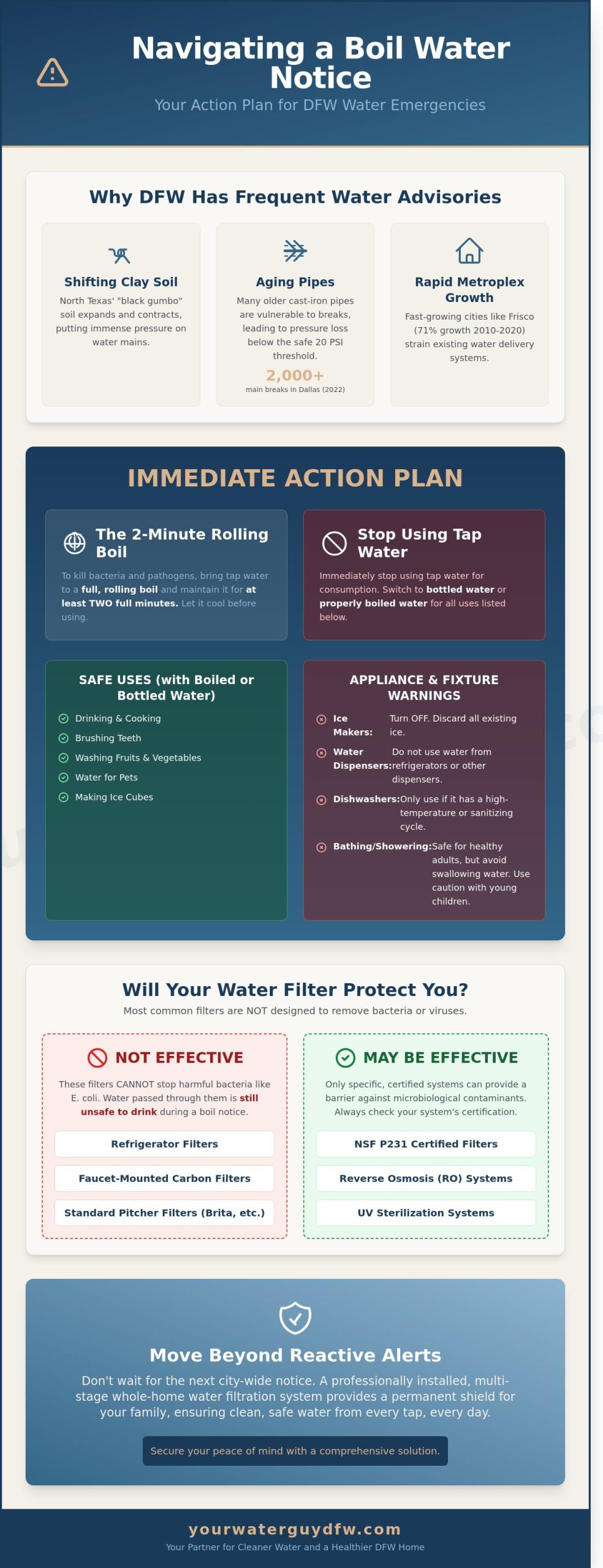
Living in the Metroplex means dealing with unique geological and structural hurdles. When your city issues a boil water notice, it isn’t just a suggestion; it’s a safety protocol triggered by specific technical failures. Most often, these notices stem from North Texas’s infamous “black gumbo” clay soil. This heavy soil expands and contracts violently with our extreme weather shifts, putting thousands of pounds of pressure on aging cast-iron pipes. In 2022, Dallas Water Utilities responded to more than 2,000 main breaks caused by this shifting ground.
Pressure is your primary line of defense. Water systems rely on constant high pressure to keep contaminants out. When a main snaps or a pump fails, the pressure inside the pipe drops below 20 PSI. This loss in pressure can allow untreated groundwater or bacteria to seep into the pipes through small cracks or joints. State law requires an automatic notice whenever pressure hits these low levels to protect your family’s health.
Infrastructure Challenges in DFW
Rapid expansion in cities like Plano and Frisco puts immense strain on existing delivery systems. Between 2010 and 2020, Frisco’s population grew by over 71 percent, forcing older infrastructure to work harder than ever. Construction crews also play a role, as accidental line strikes during road expansions frequently cause localized outages. If you’re worried about what’s coming through your tap after a repair, a free water test can give you the peace of mind you need.
Weather and Environmental Triggers
The February 2021 winter storm changed how North Texas handles water safety. Power outages at treatment plants during that freeze left millions without safe water, leading to stricter backup power requirements today. These protocols ensure that a boil water notice is issued the moment a plant loses its ability to maintain disinfection standards. Heavy rainfall also creates issues by washing sediment and organic matter into the Trinity River watershed. This runoff increases turbidity, making it harder for plants to disinfect the water. During hot Texas summers, algal blooms in reservoirs like Lake Ray Hubbard can also complicate the treatment process, sometimes leading to temporary advisories while filtration levels are adjusted.
Does Your Home Water Filter Work During a Boil Water Notice?
Many DFW homeowners mistakenly believe their refrigerator filter provides a safety net during a water crisis. This is a dangerous myth. Most standard fridge filters use activated carbon designed to remove chlorine and improve taste. They are not rated to stop biological threats. In fact, during a boil water notice, these filters can become breeding grounds for the very bacteria you’re trying to avoid. If the city warns of a potential breach, stop using your fridge dispenser immediately.
- Carbon Filters: Great for removing odors, but they don’t stop viruses or bacteria.
- Pore Size: Standard pitcher filters often have pores too large to catch microscopic pathogens.
- Biofilm Risk: Contaminants can get trapped in the filter media and multiply over time.
Reverse Osmosis and Boil Notices
Reverse Osmosis (RO) systems are much more powerful than standard filters. An RO membrane typically has a pore size of about 0.0001 microns. Since E. coli bacteria are roughly 0.5 microns wide, the membrane technically blocks them. However, Your Water Guy recommends you still boil your water during confirmed alerts. A single degraded seal or a tiny bypass in the system could let germs through. Your family’s safety isn’t worth the gamble.
Once the city lifts the notice, which often happens 24 to 48 hours after the initial alert, you must maintain your system. You’ll need to flush your RO tank and sanitize the lines. Bacteria can linger in the storage tank even after the local supply is clear. Replacing your pre-filters is a smart move to ensure your North Texas home stays protected. Because every home in the Metroplex has a unique water profile, investing in custom filtration systems designed specifically for Dallas Metroplex homes ensures your equipment is calibrated to handle our local water chemistry year-round.
UV Light: The Final Barrier
UV sterilization is the ultimate “kill stage” for any home filtration setup. It uses a specific 254nm wavelength of ultraviolet light to scramble the DNA of viruses, bacteria, and cysts. This process makes it impossible for pathogens to reproduce, effectively neutralizing them. It’s a chemical-free solution that doesn’t change the flavor of your North Texas tap water.
Your Water Guy frequently installs UV systems for DFW homes on older municipal grids or private wells. These systems provide 24/7 peace of mind. By integrating UV into a whole-house system, you create a permanent shield for every faucet in your home. It’s a proactive way to handle a boil water notice before the city even sends the text alert.
Emergency Steps: How to Stay Safe When DFW Water is Compromised
When a boil water notice hits your North Texas neighborhood, you need to act fast to protect your family. The Texas Commission on Environmental Quality (TCEQ) sets the gold standard: a full 60-second rolling boil. This isn’t just about getting the water hot. You need to see large bubbles breaking the surface continuously for one minute. This high-heat process kills harmful bacteria and parasites that chlorine might have missed during a pipe break or pressure loss. Once the minute is up, let the water cool naturally and store it in clean, covered containers.
Your kitchen appliances aren’t your friends during a water alert. Most coffee makers only reach 190 to 200 degrees Fahrenheit, which falls short of the 212 degrees required for a true boil. Turn off your automatic ice maker immediately. If it produced ice during the notice period, dump the entire bin to prevent contamination. Your pets need the same care you do. Give your furry family members cooled, boiled water or bottled water to prevent digestive upset or infections. They are part of the family, and their health matters just as much as yours.
Ensuring your pet’s well-being goes beyond just safe water; proper training is also key to a happy, healthy life together. If you’re interested in building a better relationship with your dog, you can find out more about effective training methods.
The Safe Water Checklist
Keep your kitchen safe by discarding all ice cubes made within the last 24 hours. Use bottled or boiled water for mixing baby formula and brushing teeth. Wash all raw produce with purified water only, as tap water can leave pathogens on your lettuce or fruit. Once the city lifts the notice, run your dishwasher on the high-heat sanitizing cycle while empty to clean the internal lines.
Bathing and Cleaning Protocols
Adults can usually shower safely if they don’t swallow any water. However, give infants and toddlers sponge baths to reduce the risk of accidental ingestion. If you have an open wound from a recent surgery or injury, stay out of the tub entirely to avoid infection. Use hand sanitizer with at least 60 percent alcohol after washing your hands with tap water and soap. While your laundry is safe to wash as usual, your hands and face require that extra layer of protection. Don’t take chances with your home’s health. Schedule a Free Water Test to ensure your filtration system is ready for the next North Texas water emergency.
Beyond the Notice: Long-Term Water Security for Your DFW Home
City alerts are reactive by design. Often, a boil water notice reaches your phone hours after the actual contamination event occurred. In February 2021, thousands of North Texas residents consumed tap water for half a day before official warnings were broadcast. Waiting for the city to tell you the water is unsafe isn’t a strategy; it’s a risk. Your family deserves a permanent safety net that works 24/7, regardless of municipal pipe breaks or treatment plant failures. Relying solely on local alerts leaves a gap in your home’s defense that only a professional filtration system can close.
Building Your Final Barrier
A multi-stage filtration strategy provides total coverage for your household. We recommend pairing a whole-house carbon system with a dedicated Reverse Osmosis (RO) unit under your kitchen sink. While carbon filtration removes the heavy chlorine scent and skin irritants from your shower water, an RO system acts as the ultimate gatekeeper for what you ingest. It filters out microscopic pathogens and dissolved solids that standard filters miss. This setup effectively turns your home into a personal treatment plant. Because North Texas water has specific mineral levels, often exceeding 15 grains of hardness, local calibration is essential. We tune your system to handle the exact chemical profile of DFW water so your equipment lasts for years, not months. For homeowners on private wells dealing with iron, sulfur, or other mineral issues, working with experienced well water treatment companies near me ensures your system addresses the unique challenges of North Texas groundwater. If you’re dealing with sulfur smells or iron stains from your private well, our comprehensive well water treatment near me guide provides the exact roadmap to diagnose and treat your Trinity Aquifer water for total peace of mind.
Take Control of Your Water Quality
You shouldn’t have to guess if your tap is safe. Scheduling a complimentary water assessment gives you a clear picture of your home’s current filtration needs. We provide a detailed breakdown of your water’s mineral content and purity levels without any corporate jargon. The Your Water Guy promise is straightforward. You get neighborly advice and professional solutions without high-pressure sales tactics. We treat your home like our own because we live in these same North Texas neighborhoods. Stop reacting to city emergencies and start enjoying peace of mind at every faucet. When searching for reliable water treatment companies near me, it’s essential to find a local specialist who understands our unique mineral challenges and can provide honest guidance without the pressure tactics. A tailored approach using custom filtration systems built for the Dallas Metroplex is the most effective way to neutralize the high calcium levels and heavy chlorine loads found in our local reservoirs.
Secure Your Family’s Water Before the Next DFW Emergency
Don’t wait for the next city-wide alert to scramble for expensive cases of bottled water at the grocery store. A boil water notice in the North Texas area often stems from 40-year-old municipal water mains or the unpredictable weather patterns we face every season. It’s important to remember that basic pitcher filters or refrigerator dispensers rarely stop the bacteria and pathogens present during a system failure. My specialized 5-stage reverse osmosis systems provide a 99.9% barrier against contaminants, ensuring your tap stays safe even when the city supply is compromised. As your locally owned North Texas expert, I’ve already helped over 1,250 DFW families achieve long-term water security. You won’t deal with high-pressure corporate sales tactics here; you just get honest advice from a neighbor who knows our local water chemistry. We can turn your kitchen into a reliable source of pure, refreshing water that stands up to any local advisory. Take the first step toward protecting your home today.
Get a Free Water Estimate for Your DFW Home
I look forward to helping you keep your family safe and hydrated for years to come.
Frequently Asked Questions
Can I drink water from my refrigerator filter during a boil water notice?
No, you should not drink water from your refrigerator during a boil water notice. Most standard fridge filters use carbon media designed to improve taste or remove lead, but they don’t kill 99.99% of bacteria or viruses like boiling does. Play it safe and stick to bottled or boiled water until the city gives the all-clear. Your fridge line also needs a full 5-minute flush once the notice is lifted.
How long do I actually need to boil my water in Texas?
Bring your water to a vigorous, rolling boil for at least 2 full minutes. While the CDC suggests 1 minute is enough, the Texas Commission on Environmental Quality (TCEQ) recommends the 2-minute mark to ensure all harmful microbes are destroyed. Let the water cool completely before you use it for drinking or brushing your teeth. This simple step is the most effective way to protect your family from North Texas water contaminants.
What should I do with my ice maker during a boil water advisory?
Turn off your automatic ice maker immediately and discard any ice made within the last 24 hours. Ice machines are not designed to reach temperatures that kill pathogens, and the freezing process actually preserves many germs. Once the notice is lifted, run the machine for 3 full cycles and dump that ice too before using any. This ensures the internal lines are completely cleared of any lingering bacteria or sediment.
Is it safe to shower in DFW if there is a boil water notice?
Yes, you can still shower, but you must be careful not to swallow any water. Adults and older children are usually fine, but you should give toddlers a sponge bath using boiled or bottled water instead. If you have any open wounds or a compromised immune system, wait until the boil water notice ends to take a full soak. Safety for your family is the top priority in these local water emergencies.
Do I need to change my water filters after a boil water notice is lifted?
You absolutely need to replace all your water filters once the advisory ends. Bacteria can get trapped in the filter media, creating a breeding ground for future contamination. This includes your refrigerator filter, under-sink cartridges, and whole-house systems. Flush your pipes for 5 minutes at every faucet before you install the new 5-micron or carbon replacements to ensure your home’s water is pure and safe again.
Can I use my dishwasher during a boil water notice?
Only use your dishwasher if it features a high-temperature sanitize cycle that reaches at least 150 degrees Fahrenheit. Most modern units with NSF/ANSI Standard 184 certification meet this requirement. If your machine doesn’t have this setting, wash your dishes by hand. Soak them for 1 minute in a solution of 1 tablespoon of unscented bleach per gallon of water to kill any remaining germs before air-drying them.
Is filtered water from a pitcher (like Brita) safe during an advisory?
No, pitcher filters like Brita or Pur are not safe to use during an advisory. These filters are designed to reduce chlorine taste and odors, not to filter out 99.9% of microscopic pathogens or parasites. Stick to the 2-minute boil method or use commercially bottled water for now. Your family’s health is worth the extra effort while the North Texas water supply is under repair or being treated for safety.
What happens if I accidentally drank the water before I knew about the notice?
Don’t panic if you took a sip before hearing the news. Most healthy adults won’t get sick, but you should monitor yourself for symptoms like cramps or diarrhea for the next 10 days. If you experience a fever or persistent upset stomach, contact your doctor immediately. Most DFW residents recover quickly, but it’s important to stay hydrated with safe, bottled water while you wait for the city to restore water quality.