

Would you still drink your morning coffee if you knew that “legal” water in North Texas could still contain trace levels of lead and PFAS chemicals? You likely trust the city to keep your supply safe, but that distinct bleach smell in your kitchen and those cloudy ice cubes tell a different story. It’s frustrating to pay a monthly water bill and still feel forced to lug heavy plastic bottles home from the store just to get a clean taste.
In this 2026 guide, I’ll help you answer the big question: do i need reverse osmosis for city water in the Dallas-Fort Worth area? You’ll discover how a professional RO system removes up to 99 percent of the impurities that standard municipal treatment plants often leave behind. We’ll look at the specific challenges facing our local pipes, how to achieve better-tasting food, and why your family’s peace of mind is worth more than just meeting a minimum government standard. It’s time to turn your tap into a source of pure, refreshing water you actually enjoy.
Key Takeaways
- Understand the vital difference between “EPA safe” and “consumer pure” to ensure your North Texas home gets more than just the legal minimum.
- Learn why DFW cities rely on heavy chlorine and chloramines and how these disinfectants impact your family’s daily drinking water quality.
- Discover the specific local contaminants that help you answer the question, “do i need reverse osmosis for city water,” even if your municipal supply meets current standards.
- Compare RO technology against standard fridge filters to see how the “gold standard” of filtration blocks particles 100x smaller than carbon alone.
- Identify common household warning signs like “pool water” smells and cloudy ice that indicate your kitchen is ready for a professional 5-stage system.
Do I Need Reverse Osmosis for City Water in Dallas-Fort Worth?
You’re likely asking yourself, do i need reverse osmosis for city water when the city sends out reports saying everything is fine? In North Texas, the answer depends on your personal standard for “clean.” Reverse osmosis (RO) is the gold standard for home purification because it doesn’t just filter water; it strips away microscopic contaminants that standard carbon filters often miss. It’s the difference between water that meets a legal minimum and water that is truly pure for your family to drink.
Many DFW residents are concerned about Total Dissolved Solids (TDS). This is a measurement of the minerals, salts, and metals dissolved in your tap water. While a certain level of TDS is expected, the high levels found in our local supply can affect the taste of your coffee, the clarity of your ice, and the health of your household. It’s completely normal to feel uneasy about what’s in your glass, especially when you see white scale buildup on your fixtures every week.
Understanding EPA “Legal Limits” vs. Your Family’s Health Goals
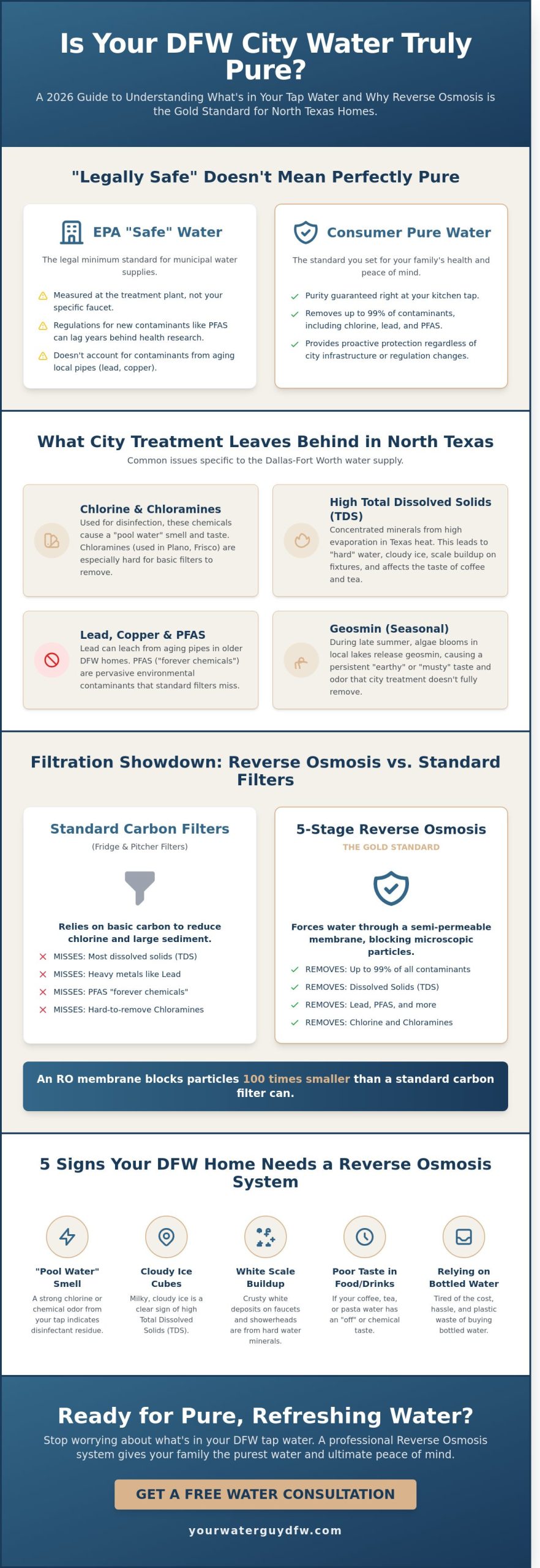
City water reports focus on averages across thousands of miles of infrastructure. They measure safety at the treatment plant, but they don’t account for the reality of what comes out of your specific faucet. The EPA currently regulates over 90 contaminants, yet thousands of other substances, like PFAS “forever chemicals,” often wait years for official regulations to catch up with modern health research. There is a massive lag time between identifying a risk and enforcing a limit.
If you live in older neighborhoods in Dallas or Fort Worth, lead and copper from aging pipes can leach into your supply long after the water leaves the treatment facility. Choosing an RO system means you aren’t waiting for a government agency to update their standards before you take action. You’re taking control of your home’s environment today and ensuring your family isn’t the filter for the city’s plumbing issues.
The Specific Mineral and Chemical Profile of North Texas Municipal Water
Our water primarily comes from sources managed by the Tarrant Regional Water District and the Trinity River Authority. Because North Texas sees roughly 232 sunny days a year with temperatures frequently hitting triple digits, our reservoirs face high evaporation rates. This leaves behind concentrated minerals, resulting in the “hard” water that defines our region. When you ask, do i need reverse osmosis for city water, consider the seasonal changes in the DFW area.
- Summer Taste: During late summer, algae blooms in our lakes release geosmin. This causes that “earthy” or “musty” taste that persists even after city treatment.
- Mineral Concentration: High evaporation in Texas heat leads to a denser concentration of calcium and magnesium in the remaining water supply.
- Chemical Residuals: Cities use chlorine or chloramines to keep water safe during transit, but these chemicals leave a harsh smell and taste in your glass.
An RO system acts as a final barrier, removing these seasonal inconsistencies and providing a crisp, refreshing experience regardless of the weather outside. It’s a simple solution that turns your kitchen tap into a source of premium water.
What DFW City Water Treatment Leaves Behind: Chlorine, PFAS, and Lead
Your local water department works hard to meet the Safe Drinking Water Act standards. However, “legal” water isn’t always the same as “pure” water. When homeowners ask, “do i need reverse osmosis for city water,” they are usually reacting to the secondary contaminants that city plants aren’t required to remove or the chemicals added during the treatment process itself. In North Texas, our infrastructure relies on heavy disinfection to keep bacteria at bay as water travels through miles of underground pipes. This process is necessary for safety, but it leaves behind byproducts that affect your health and your home.
The Problem with Chloramines in Plano, Frisco, and McKinney
Cities like Plano, Frisco, and McKinney often utilize chloramines, which is a mixture of chlorine and ammonia. While this keeps water “clean” for longer distances, it creates a unique set of problems for your home. Chloramines are significantly harder to remove than standard chlorine. A basic carbon pitcher will barely make a dent in them. Many local families report skin irritation, respiratory sensitivity, and a distinct chemical taste in their coffee. If you’re tired of your tap water smelling like a public pool, a standard filter isn’t the answer. You need a system designed to handle the tough bond of ammonia and chlorine.
Emerging Contaminants: PFAS and Microplastics in the Trinity River
Recent years have brought “forever chemicals” or PFAS into the spotlight. In April 2024, the EPA established strict new limits for these substances because they don’t break down naturally in the environment or your body. These chemicals, along with microplastics and pharmaceutical runoff, are frequently detected in surface water sources like the Trinity River and our local lakes. Standard municipal treatment isn’t designed to catch these microscopic particles.
Learning how reverse osmosis systems work reveals why they are the gold standard for home protection. The RO membrane is one of the few technologies capable of blocking PFAS and microplastics at the molecular level. While the city does its job to keep the water “safe,” a reverse osmosis system does the job of making it pure.
Protecting your family means looking beyond the minimum legal requirements. If you’re concerned about what’s coming out of your kitchen tap, it might be time for a Free Water Test to see exactly what your city’s treatment plant left behind. Do i need reverse osmosis for city water? For most DFW families who want total peace of mind and bottled-water quality at home, the answer is a clear yes.
Reverse Osmosis vs. Fridge Filters: Which is Best for North Texas Homes?
Many Dallas homeowners ask me, “do i need reverse osmosis for city water if my fridge already has a filter?” It is a fair question. Most fridge filters and pitchers use a basic carbon block to improve taste. Think of these like a screen door. They stop the big bugs, like chlorine and some sediment, but they can’t stop the microscopic particles that actually affect your family’s health.
The biggest difference lies in the micron rating. A standard fridge filter usually handles particles down to 1 or 5 microns. A high-quality reverse osmosis membrane filters down to 0.0001 microns. That makes RO filtration 100 times more effective than carbon alone. When you want to remove heavy metals, fluoride, or dissolved salts common in our local supply, a basic fridge filter simply isn’t built for the job.
- Fridge Filters: Primarily reduce chlorine taste and odor.
- Pitcher Filters: Small capacity, high maintenance, and limited contaminant removal.
- Reverse Osmosis: Removes up to 99% of total dissolved solids (TDS) and provides bottled-quality water at your sink.
Why Pitcher Filters Often Fail the DFW Taste Test
North Texas water is notorious for high TDS levels, often ranging from 200 to 400 parts per million. These minerals quickly exhaust the tiny amount of carbon found in pitcher filters. When a filter becomes saturated, you experience the “breakthrough” effect. This is when trapped contaminants actually leak back into your “clean” water because the filter can’t hold any more. For reliable, year-round pure drinking water in Dallas-Fort Worth, you need a system that flushes away those impurities rather than just storing them in a small plastic jug.
The Real Cost: RO Systems vs. DFW Bottled Water Delivery
If you’re currently relying on 5-gallon jug delivery, you’re likely overpaying for convenience. A family of four typically consumes about 15 to 20 gallons of drinking water per week. At current DFW delivery rates, that can cost $50 to $70 every month. Over a year, you’re spending upwards of $800 on water you still have to lift and store.
When you look at the math, the “payback period” for a professionally installed RO system is usually less than 15 months. You also eliminate the environmental impact of plastic waste. One RO system can prevent over 3,000 single-use plastic bottles from entering Texas landfills every year. It’s a cleaner choice for your wallet and our local environment. If you’re still wondering “do i need reverse osmosis for city water,” consider how much you’re currently spending just to avoid the tap.
5 Signs Your DFW Home Needs a Reverse Osmosis System
You shouldn’t have to guess if your family’s water is high quality. Often, the signs are staring you right in the face every time you open the tap or pull a glass from the cabinet. If you find yourself asking, “do i need reverse osmosis for city water,” your own kitchen usually provides the evidence. While Dallas municipal water meets federal safety standards, those standards allow for levels of minerals and chemicals that affect your daily life.
Look for these five indicators in your North Texas home:
- The “Pool Water” Aroma: If your kitchen smells like a public swimming pool when you run the tap, you’re smelling high chlorine levels.
- Cloudy Ice Cubes: Clear ice is a sign of purity. White, opaque cubes mean minerals and gases are trapped inside.
- Bitter Coffee and Tea: Water makes up 98% of your morning brew. If your coffee tastes metallic or bitter, the water chemistry is masking the bean’s natural flavor.
- Crusty Faucet Buildup: White, chalky scales on your plumbing fixtures indicate high mineral content that eventually clogs your aerators.
- Lingering Aftertaste: Pure water should be refreshing. If you notice a “heavy” or salty finish, your Total Dissolved Solids (TDS) are likely too high.
Identifying the “Texas Tap Water” Smell and Taste
North Texas water is notorious for its seasonal shifts. During summer months, algae blooms in our reservoirs can create an earthy, musty scent. To combat this, cities often increase chlorine or chloramine dosages. Your nose is a powerful tool for detecting these changes. A reverse osmosis system removes 99% of these aesthetic contaminants, giving you bottled-water quality right at the sink. Trust your senses. If the water smells like bleach, it’s time to filter it out.
Hard Water Spots and High TDS Levels
Total Dissolved Solids, or TDS, represents the concentration of dissolved minerals, salts, and metals in your supply. High TDS levels create a “thick” mouthfeel and leave spots on your glassware. While many homeowners install a softener to handle scale, a water softener with reverse osmosis is the gold standard for total home protection. The softener protects your pipes, while the RO ensures your drinking water is truly pure. We provide a free water test to show you exactly what your TDS count is before you make a decision.
Deciding “do i need reverse osmosis for city water” becomes much easier once you see the numbers. High TDS isn’t just a nuisance; it’s a sign that your water is working against your appliances and your taste buds. Your Water Guy DFW can help you bridge that gap with a simple, effective solution.
Stop settling for “okay” water. Schedule your free water test with Your Water Guy DFW and get the facts about your home’s supply.
The Your Water Guy Approach: High-Performance RO for North Texas Families
Deciding if you really do i need reverse osmosis for city water comes down to one thing: your family’s peace of mind. At Your Water Guy, we don’t treat you like a number in a corporate database. We’re your neighbors, and we’ve seen exactly what North Texas municipal water looks like before it hits our filters. Our 5-stage system isn’t a generic kit from a big-box shelf. It’s a high-performance solution built to handle the specific mineral and chemical profile of DFW water.
We believe in a “No-Pressure” promise. You won’t find pushy salesmen here. We provide the facts, conduct a free water test, and let you make the choice that fits your budget and health goals. If you want to dive deeper into the technical specs, check out our Reverse Osmosis System Fort Worth Buying Guide for a complete breakdown of what works best in our region.
Why Our 5-Stage RO System Outperforms Big-Box Alternatives
Generic systems often fail because they aren’t built for the heavy mineral load in Texas. Our 5-stage process is different. It starts with a high-capacity sediment filter to catch dirt and rust. Then, we use dual carbon blocks. This is critical because DFW cities use chloramines that standard single-carbon filters struggle to remove. The water then passes through a high-performance membrane and a final polishing filter for a crisp taste.
- Sediment Stage: Removes physical particles that clog home appliances.
- Dual Carbon Blocks: Specifically targets the “pool water” smell and taste common in Dallas.
- High-Capacity Membrane: Designed to provide enough pure water for large families without a drop in pressure.
- Durability: Our components are rated for the high-pressure surges often found in local municipal lines.
Professional Installation: Why Calibration Matters in DFW
Many homeowners try the DIY route only to deal with slow leaks or a poor water-to-waste ratio. A system that isn’t calibrated correctly can waste four gallons of water for every one gallon it produces. When Your Water Guy handles your installation, we calibrate the system based on your specific city’s water pressure. This ensures maximum efficiency and protects your plumbing from unnecessary stress.
When you’re wondering, do i need reverse osmosis for city water, remember that the equipment is only half the battle. The other half is having a local expert who stands by the work. To keep your system performing at its best year after year, following a consistent water filter system service schedule tailored to North Texas conditions is essential. We ensure every connection is secure and every filter is seated perfectly. Contact Your Water Guy today for a neighborly consultation. We’ll help you get the pure, safe water your family deserves without the corporate headache.
Take Control of Your Family’s Water Quality Today
You shouldn’t have to wonder what’s hiding in your glass every time you take a sip. While DFW municipalities work hard to meet basic standards, the EPA’s 2024 final ruling on PFAS highlights that even trace amounts of forever chemicals pose long-term health risks. A standard fridge filter isn’t enough to catch these microscopic threats or the lead that often leaches from older North Texas infrastructure. When you ask, do i need reverse osmosis for city water, you’re really asking if your family deserves the highest level of protection available in 2026.
Your Water Guy DFW is locally owned and operated right here in the Metroplex. We specialize in expert 5-stage systems specifically calibrated for the unique mineral profile of North Texas water. You’ll get a no-pressure, neighborly consultation that focuses on your needs, not a sales pitch. It’s time to ditch the bottled water and enjoy pure, refreshing flow right from your kitchen tap.
Get Your Free DFW Water Test and RO Quote Today!
We’re ready to help you secure the safest water possible for your home.
Frequently Asked Questions
Is city water in Dallas-Fort Worth safe to drink without a filter?
Yes, DFW water meets all federal EPA safety standards, but legal limits don’t always mean the water is ideal for your family. The 2023 Dallas Water Quality Report shows the city monitors over 180 different contaminants. While it’s technically safe, many local residents dislike the 1.0 ppm average chlorine levels and the taste of seasonal algae blooms. Filtering your water provides an extra layer of protection and significantly improves the flavor of every glass.
Does reverse osmosis remove fluoride from DFW city water?
Yes, a high-quality reverse osmosis system removes 85% to 95% of fluoride from your tap water. Dallas Water Utilities adds fluoride to the municipal supply at a target level of 0.7 mg/L for dental health. If you want total control over what your family consumes, an RO system is the most reliable tool for the job. It uses a specialized semi-permeable membrane to catch these tiny particles that standard pitcher filters often miss.
How much water does a reverse osmosis system waste in Texas?
Traditional RO systems typically send 4 gallons of water to the drain for every 1 gallon of purified water they produce. Modern high-efficiency systems have improved this ratio to 1:1, making them much more sustainable for North Texas homes. While this sounds like a lot, the average family of four uses less than 3 gallons of drinking water daily. Your total monthly “waste” is roughly equivalent to flushing a toilet two extra times per day.
Do I need a whole-house RO system or just an under-sink unit?
Most North Texas homeowners only need an under-sink unit for their drinking and cooking needs. Whole-house RO systems are rare in the DFW area because they require large storage tanks and can be aggressive on copper plumbing lines. If you’re wondering, do i need reverse osmosis for city water, start with a point-of-use system at your kitchen sink. This provides pure water where you consume it most without the massive footprint of a whole-home setup.
Can I install a reverse osmosis system myself in my North Texas home?
You can install a DIY kit in about 2 to 3 hours if you’re comfortable using a drill and basic hand tools. However, many DFW homeowners prefer professional installation to avoid common issues like improper drain line connections or slow leaks under the kitchen cabinet. A pro ensures your storage tank is pressurized correctly and the air-gap faucet functions without making annoying noises. This saves you from potential water damage and ensures the system runs perfectly.
Will a reverse osmosis system fix the smell of my tap water?
Yes, reverse osmosis is incredibly effective at removing the “pool” smell of chlorine and the “earthy” scent common during North Texas lake turnovers. The multi-stage process uses carbon blocks to adsorb odors and organic compounds before they reach your glass. By the time the water passes through the final polishing filter, it’s odorless and crisp. You’ll notice the difference immediately in your morning coffee and your clear, odorless ice cubes.
How often do I need to change RO filters for DFW city water?
You should replace your sediment and carbon pre-filters every 6 to 12 months to protect the main membrane from chlorine damage. The RO membrane itself usually lasts 2 to 3 years depending on how much water your household uses. Because DFW water has a total dissolved solids count often ranging between 150 and 300 ppm, sticking to this schedule is vital. Neglecting these changes can lead to reduced water flow and lower purification quality over time. Our complete water filter system service guide for the Dallas Metroplex breaks down exactly what maintenance your system needs and when, so you never have to guess.
Does reverse osmosis remove the healthy minerals from my water?
Yes, reverse osmosis removes about 98% of all dissolved solids, including minerals like calcium and magnesium. While some people worry about this, the 2023 Dallas Water Quality Report shows these minerals are present in relatively low amounts anyway. You get the vast majority of your daily minerals from your food, not from your tap water. If you prefer the taste of mineral water, many of our systems include a remineralization stage to add back beneficial electrolytes.